

From an upcoming, much longer, post detailing my visit to Stanford University’s Clinical Anatomy Lab, where I worked with cadavers:
I, along with many others, talk about how certain parts of the spine respond to certain types of motion. Most prominently talked about is the lower back not responding well to rotation. I’ve seen research on this, read Stuart McGill’s work, yada yada.
What’s ironic here is many mention this fact, yet when it comes to application all you see is people talk about flexion and extension. We’ll come back to this.
My instructor helped me see how the spine prefers to move by looking closely at the facet joints.


The facet joints are how the vertebrae move in relation to one another.

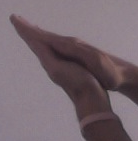
The easiest way to visualize this is to use your hands. Put one on top of the other. For the cervical vertebrae the facets (hands) are slanted forward:
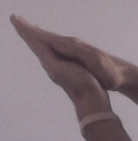
For the thoracic they are pretty much upright:

And for the lumbar they are upright. However, instead of being vertical they’re horizontal:


Remember, the facet joints move on one another. Can you see how the cervical spine is built more for rotation, the thoracic more for side to side (lateral) motion, and the lumbar more for up and down (flexion and extension)?
Cervical; lateral view:

Which is similar to someone rotating their head side to side:

Thoracic; lateral view:

The lateral thoracic view is tough to see. You can see things better by looking at a posterior view:


Lumbar; lateral view:


Similar to someone bending forward and back:

It makes sense then people with neck issues tend to fit into a too much extension pattern, those with thoracic into a too much flexion pattern, and those with lumbar into a too much rotation pattern. These spinal segments don’t like these motions.
You may see people with too much cervical flexion or thoracic extension, but this is really rare. The point is you don’t often see people with rotation issues at the neck or side bending issues at the thoracic spine. At least not to the point of causing cervical or thoracic pain. These spinal segments like these motions.
Going back to my earlier comment about focusing on lumbar extension and flexion: The lumbar spine is actually made for this type of movement! No, that doesn’t mean you want to deadlift with a rounded back. But, it does mean you should probably take your obsession with flexion and extension and concomitant focus on rotation, and flip that around.
Lastly, this is a dimmer switch. In regards to rotation, as you move down the spine the switch goes from bright (embracing rotation)-yet not blinding, to dark (disdaining rotation) -yet not blacked out. It’s not like all the cervical spine is great with rotation and horrible with flexion / extension. There is a transition as you move down the spine. What you takeaway from this is certain parts of the spine handle certain motions better.
Using these biomechanical observations with what everyday people tend to do: There’s really no reason to do anything resembling extension at the cervical spine, flexion at the thoracic spine, or twisting at the lumbar spine. You’re playing with fire.
–