I’m going to reference Scapular winging: anatomical review, diagnosis, and treatments often.
–
Anatomy of scapular winging (muscular)
Serratus anterior
Of course, we have to start with this muscle.

The serratus anterior protracts and upwardly rotates the scapula.

Let’s use a nice quote from the paper to get more specific. Pictures and bolding from me:
“The serratus anterior is a broad flattened sheet of muscle originating from the first nine ribs and passes posteriorly around the thoracic wall before inserting into the costal surface of the medial border of the scapula.
(Fancy talk for it goes from the ribs to the scapula.)
The serratus anterior has three functional components. The superior component originates from the first and second ribs and inserts into the superior medial angle of the scapula. This component serves as the anchor that allows the scapula to rotate when the arm is lifted overhead.
The middle component of the serratus anterior originates from the third, fourth, and fifth ribs and inserts on the vertebral border of the scapula, serving to protract the scapula.
The inferior component originates from the sixth to ninth ribs and inserts on the inferior angle of the scapula. This third portion serves to protract the scapula and rotate the inferior angle upward and laterally.
As a whole, the main function of the serratus anterior is to protract and rotate the scapula, keeping it closely opposed to the thoracic wall and optimizing the position of the glenoid for maximum efficiency for upper extremity motion.”


It’s not just about the serratus anterior
The serratus anterior is not the only muscle impacting a winging scapula. When a scapula wings it’s because it isn’t held close to the rib cage. The serratus anterior gets a lot of attention because it’s anterior to the scapula, and attaches to the scapula. When a scapula wings it often displaces posteriorly. Naturally, the thinking goes the serratus anterior is “long and weak” because the scapula isn’ t being held close to the ribcage.
However, other muscles connect anterior to the scapula, and connect to the scapula.
Trapezius

Because the spine is ventral to (in front of) the scapula the trapezius can pull the scapula a bit anteriorly. That is, closer to the ribcage.
Parts of the trapezius also fall on top of the shoulder blade.

If the trapezius is on slack, or not firing properly, the compression on the scapula lessens. Making it more likely the shoulder blade won’t be as tight to the ribcage, aka wing.
Rhomboids
For many of the same reasons above, the rhomboids can play a role in the shoulder blade winging too. Because this is so rare (the authors go over this too), I’m not going to cover it.
Position of the scapula
Due to the attachment sites of the above muscles, we can get a good feel for which muscles need work by the position of the scapula. A nice chart from the paper:


Right scapula front view.

Right scapula back view.
Right shoulder winging due to issues with the serratus anterior (it gets progressively worse):
–
See how the scapula is traveling excessively medially and superiorly?


Winging due to issues with the trapezius:

From the paper: “Notice the lateral displacement of the scapula with the superior angle more lateral to the midline than the inferior angle.”
An important note here: I don’t think it’s feasible to fully separate these two impairments. When a serratus anterior issue is present it’s pretty much guaranteed there’s an issues with something like the trapezius. For instance, while this has serratus issues:
You can see issues with the trapezius as well. The superior angle (where the trapezius attaches) is lateral to the inferior angle. A sign the trapezius is also not firing like it should be.

–
Anatomy of scapular winging (nerve)
Long thoracic nerve
Much like the serratus anterior, of course we have to go over this nerve. The long thoracic nerve is part of the brachial plexus.

The brachial plexus is a group of nerves which run down from the neck, under the clavicle, connecting to various points around the shoulder. 
-Image credit and copyright to Kenhub (great anatomy site!)
The long thoracic nerve connects into the serratus anterior:


Because this nerve is what gets the serratus anterior to fire, and people with scapular winging often have so much trouble getting their serratus to work, the long thoracic nerve gets a lot of attention. However, attacking the nerve doesn’t get us anywhere. We need to go after why the nerve has a problem. Why is it having trouble firing, thus the serratus anterior is having trouble firing. The nerve doesn’t just sporadically stop working one day.
–
Figuring out the cause of scapular winging
“The serratus anterior is weak” is not a cause. “The long thoracic nerve isn’t working” is not a cause. Why are there issues with the serratus anterior? Why did it become weak? Why is it not firing properly? Why is the long thoracic nerve not helping?
Muscular
As I went over above, we’re primarily interested in getting the trapezius and or serratus anterior to work better. Muscles which help hold the scapula to the rib cage and lift (rotate) it upwards. With that, it’s logical to assume muscles which perform the opposite functions -pull the scapula away from the rib cage and or rotate it downwards- are likely working too much. Muscles such as, but not limited to, the rhomboids or pec minor. We want to calm them down. If they’re too active they can limit the ability of the trapezius and serratus anterior to do their jobs.
Nervous
We’re interested in anything which could limit the ability of the long thoracic nerve to fire. We’re primarily concerned with compression of the nerve. From the paper (when discussing the long thoracic nerve):
“Proposed vulnerable sites for injury include compression of the nerve between the clavicle and first rib and traction within the nerve’s fascial sheath.”
The clavicle and first rib may come closer together pinching the long thoracic nerve between them.

In my experience, this most often manifests with the clavicle / shoulder drooping.

Which goes hand in hand with our discussion of muscles pulling the shoulder down. The overactive muscles which may cause a shoulder to droop, are the same muscles which oppose the serratus anterior and trapezius.
This is the long way of saying you can’t really separate nerve issues from muscular issues. They work together. Granted, I once saw a woman who had her long thoracic nerve severed because of a mastectomy. Her winging was truly a nerve problem. But that’s the rare case. We’re more concerned with our average person.
So, how do these certain muscles become dominant? How does this nerve get compressed?
–
Daily activities causing issues with scapular winging
I’m going rattle off a bunch of scenarios where the shoulders are being depressed / downwardly rotated.
Bra Straps
The downward pull of bra straps can cause the shoulders to become depressed over time.

This is especially poignant for those who carry a considerable amount of weight in their bra.
Carrying heavy objects

Much like the bra strap comments.
Computer Posture
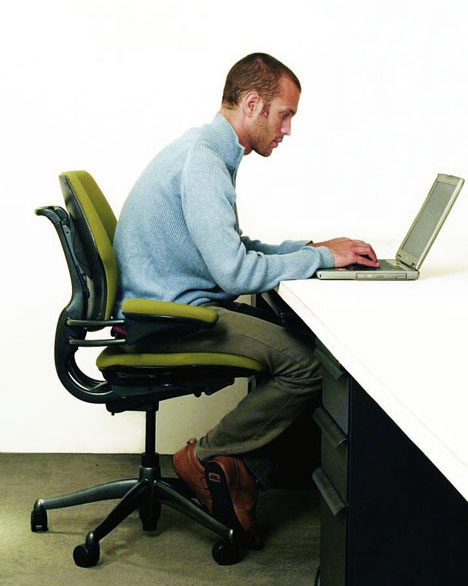
The forward head posture causes the levator scapulae (downward rotator) to pull on the scapula
The internal rotation (hands / arms turned down and in) can cause stiffness in the pecs and lats. Both of which can limit our ability to get our arms up.
Leaning on elbows

Notice the right shoulder protruding
This can push the shoulder into retraction, stiffening the rhomboids.

Next, this can indirectly cause winging. When leaning on the elbows the humerus can become displaced anteriorly (forward) and or superiorly (upward), lengthening the subscapularis.

A muscle which depressed the humeral head, pulling it posteriorly (backward) and inferiorly (downward).
When the subscapularis is lengthened it may shut down causing other humeral head depressors, such as teres minor and infraspinatus, to work more than they should.

These muscles can then stiffen up. This stiffness may appear when someone internally rotates their arm. Notice the winging during internal rotation here:

Credit to Diagnosis and Treatment of Movement Impairment Syndromes (Great book!)
I didn’t go over this in the initial anatomy section, but stiff external rotators of the humerus can cause winging as well. Because these external rotators connect 1) anterior to the scapula and 2) to the scapula, similar to the muscles I went over earlier. The difference being these muscles internally rotate the scapula (away from the ribs), while the others externally rotate it (close to the ribs).

–
Standing with hands on hips

This goes hand in hand with the above. The internal rotation causes issues with the lats and pecs, and the elbows behind the humerus promote anterior translation of the humeral head (stretching the subscapularis). All these muscles pull the arm downwards as well. Something we want to avoid in exercise too.

–
Exercise routines causing issues with scapular winging
Too much pulling
Exercises such as DB rowing, chin ups, lat pulldowns, chest supported row, all work on muscles which downwardly rotate and retract the scapula, as well as extend the humerus. Muscles like the rhomboids, lats, teres minor and infraspinatus. As we’ve seen, if anything, in someone with scapular winging we want to atrophy these muscles.
Too much work in horizontal plane
Horizontal meaning the arms move forward (in front of body) and back (behind body), rather than up (overhead) and down (below head).
Going with that, horizontal pushing exercises, such as push-ups, bench pressing, DB bench pressing, all work the pecs to a great degree. Muscles we again want to calm down.
Yes, it’s true some scapular protraction is present. But this is where we go back to the function of the serratus anterior.
“the main function of the serratus anterior is to protract and rotate the scapula”
And there’s minimal, if any, upward rotation in any exercise only taking place in the horizontal plane. Now we can see why something like the push-up plus exercise is pretty much futile.


Some people will lift the arms up a bit higher to place the shoulders in more of an upwardly rotated position. If you want to really upwardly rotate the scapula you know what you could do even more of? Lift the arms higher. Like, all the way up. Isn’t this the goal anyways? To be able to lift the arms all the way up?
Furthermore, exercises like the push-up plus and others may promote scapular protraction while simultaneously promoting scapular retraction.


–
Whatever you may be promoting in scapular abduction (protraction) you’re offsetting with adduction (retraction). Something you rarely want in a scapular winging issue, or most shoulder issues for that matter.
Note the similarities:
Pain during arm elevation due to excessive scapular retraction:
Looks pretty similar to the position of a push up plus:


Sure, you could cue around this (I rarely ever see someone do so), but you still have to account for the fact upward rotation is not being sufficiently attained.
Lack of overhead work
What you end up concluding is the way to solve these types of issues is not to avoid overhead work, but to embrace it. Overhead work enables us to:
- Fully utilize the serratus anterior and trapezius (upward rotators and preventers of winging)
- Stretch the pecs, lats, rhomboids, levator scapula (downward rotators)
- Stretch the infraspinatus and teres minor
This doesn’t mean you immediately start forcing your arm overhead. Some people need to very slowly work on their overhead range of motion. I’ve seen many a people who could only go a couple inches before their pain kicked in, and that’s ok. We don’t push into that pain, and we’ll see the range of motion improve with time.
Forcing me to disagree with this statement from the authors:
“Upon diagnosis, patients should be advised to avoid overhead use of the effected extremity and to avoid activities that cause pain.”
It’s not so much what you do, but how you do it. It’s not so much you shouldn’t bring your arms overhead, it’s how you go about doing it.
You’ll never be able to get your arms vertical by only working them in the horizontal.
–
If you’re looking for some other steps you can take to help with scapular winging, specifically during the day, such as while typing and sitting, you may be interested in this.


Kalen
August 17, 2013
That’s a lot of good info. But one question, do people usually get rid of the actually winging appearance of the scapula or just the pain that sometimes comes with it? I am ever so ready to get rid of this appearance. It has only harmed my confidence, I do not feel any discomfort and have full range of movement. I did do a lot of swimming in 5th – 8th grade. Stopped doing that and am now in 12th grade. I began to bulk up and have seen the winging appearance seem a little less noticeable but… I just want to know if strengthening the serratus will actually bring my scapula back onto my ribcage when in a static standing position? :/
reddyb
August 19, 2013
Hey Kalen,
People do get rid of the appearance as well.
There are some who may have the appearance of a winging scapula, say, while standing, but the appearance can be due to a hypertrophied subscapularis. If the person has the winging appearance while standing, but no noticeable winging during movement, they probably fit into this category.
Tough to say what’s happening with you. If you recently bulked up, it may be the size of the subscapularis giving the appearance. Being so young though, it may be you have winging issues, but haven’t reached the point where it causes pain.
Kalen
October 5, 2013
I have visited two physios and they say its quite mild winging. Just a muscle imbalance. I used to have tight pec minor which pulled my shoulders forward… spent so many earlier years with crap posture, rounding the shoulders forward and slouching in chairs at school… carrying a heavy school bag that sagged off my back when carrying it. The swimming I understand is not good if you have weak rotator cuffs to begin with. I did suffer a broken collarbone in 9th grade. I landed on my left shoulder and hit my head too… however both wing equally and have basically winged as far back as I can remember… which is before highschool. I used to play cricket from 3rd grade up until 9th grade before I broke that collarbone… being out of action for the healing period of the collarbone caused me to lose interest in the sport. I have been given serratus anterior exercises, lower trap exercises, pec minor stretches, rotator cuff strengthening exercise, upper trap stretches.. I added I rhomboid stretches as I know this muscle acts against the serratus anterior’s function. I will get an EMG to check for nerve damage.. I do not suspect I have nerve damage because I don’t show any symptoms. I have studied every corner of information on this affliction. I have not been able to find many cases or people reporting that the exercises their physio gave them flattened out their blades. I also seem to be unable to find cases on mild scapula winging due to muscle imbalances. However I also read this is a common physical appearance in people. Considering my circumstances, should I expect to see my shoulder blades sit flat with exercises? The physio said 6-8 weeks before I see results, I’ve been on them for 2 weeks. I am just worried they wont work and worried about spending more money on more appointments in attempts at fixing this as it is also harming my patience and self confidence. that is a mouthful to read and I am SO sorry for that but I guess you could say I’m a little frantic about fixing this. Thanks for your reply to my first comment as well.
reddyb
October 6, 2013
-Scapular winging:
http://www.youtube.com/watch?v=ak7xd4M7Nqo
Scapular winging corrected (meaning the appearance is corrected too):
http://www.youtube.com/watch?v=WHPrQ5LvJvs
Example of a different, yet common, issue being corrected (another appearance issue too):
http://b-reddy.org/2013/08/18/example-of-improving-a-low-shoulder/
-Two weeks is not enough time: http://b-reddy.org/2013/08/01/how-long-does-it-take-to-get-rid-of-chronic-pain/
-The paper I reference in this post talks about muscle imbalances and scapular winging, with specific cases. Shirley Sahrmann’s books go over specific cases too.
Other thoughts:
-No offense, but keep in mind at ~18 years old, it’s unlikely you’ve studied every corner of any affliction, much less something involving human anatomy.
-It’s not just what or how many exercises you’re doing, it’s how you’re doing them. If your scapula is winging during all those exercises, it doesn’t really matter what you’re doing.
-You seem to have a shotgun approach, doing everything you can think of, which rarely works.
-A bunch of stretches geared at a bunch of specific muscles, e.g. a pec minor stretch, is unlikely to the job done. You seem to have too much of a reductionist mindset. Ideally, you get more bang for your buck out of an exercise. A serratus anterior exercise should not only work the serratus, but also stretch the pec minor and rhomboids.
-Going with my first note in this section, in this post I mention the importance of training -not stretching- the upper traps. Yet, you reference doing upper trap stretches.
-As I mentioned in this first comment, if your subscapularis is hypertrophied, that might be all there is to your winging scap appearance. In which case none of these exercises are going to help. If you truly wanted to correct things, you’d have to atrophy the subscapularis.
-Lastly, you could be doing all the right exercises, stretches, etc. However, you don’t say much about what you’re doing the other 23 hours of the day. http://b-reddy.org/2012/08/08/why-youre-still-in-pain/
Kalen
October 6, 2013
Most of the day I spend focusing on my posture as I believe this contributed to my condition in the first place. Yes I have not searched every corner that was an exaggeration to say that Ive spent a lot of time researching this. My posture is generally decent now. If I strengthened the serratus, lower traps, and any other weak muscles to their maximum potential whilst stretching the tight muscles to optimum lengths wouldn’t that solve the issue? Basically if I achieved a near perfect muscle balance. My subscapular muscles are not big at all and I should have posted photos to avoid that confusion. I only got worried due to the small amount of reports on winged scapula exercises and stretches. Almost every thing ive searched is related to long thoracic nerve damage… which I more than likely don’t have. I am very thankful for your responses and am starting to believe I can achieve my aesthetic goals in the future. Thank-you.
reddyb
October 8, 2013
No, you need to achieve optimal movement. Having everything be in balance is a good way to help optimal movement. But you could have everything be perfectly balanced strength / length wise, however, that doesn’t mean the brain will use all the muscles in the correct sequence. You’re thinking about this too much in terms of “strengthen this, lengthen that.” Think more in terms of “Stop my scapula from winging.” Or “Move my scapula without it winging.”
Kalen
October 17, 2013
The exercises ive been given are supposed to and are currently improving my dynamic and static winging. The lengthen and strengthen mentality is directly related to the mentality of stopping my scapulae from winging. I do not see how the brain needs to use the muscles in sequences when the issue here is weakness.
reddyb
October 18, 2013
Out of curiosity, if the issue is true weakness, why are you trying to strengthen the rotator cuff? How does a weak cuff cause scapular winging?
Kalen
October 18, 2013
The rotator cuffs become weak due to the scapula stabilisers becoming weak. Strengthening both is beneficial according yo my PT.
reddyb
October 21, 2013
It’s pretty common for the teres minor and infraspinatus to be stiff in scapular winging though: http://b-reddy.org/2013/02/12/the-rotator-cuff-is-not-a-muscle/
Kalen
October 6, 2013
One other thing, in reference to the link you posted about chronic pain. I do not experience any pain and I have never experienced pain with this before. And I am also aware 2 weeks is not enough. I am just needing clarification that I will have this sorted on the first attempt rather than going through trial and error.
reddyb
October 8, 2013
Hard for me to answer this without knowing -specifically- what you’re doing.
Kalen
October 13, 2013
What I’m doing is strengthening lower traps, serratus anterior, rotator cuff muscles, stretching the pec minor. The pec minor has been released now and my shoulders sit nicely and I find that the winging has subsided slightly since releasing it. Now all I have to do is strengthen what’s weak.
Morgan
October 15, 2013
New to the site… all great stuff. I have a terrible time activating my mid/lower trap. Incredibly tight pec minor and anterior delt. Neck is tight. Feel like I’m winging to the side 24/7. Don’t know what it all stems from, but I feel like certain muscles just aren’t in the right place (lats, traps, etc). Tried a ton of different things over the past year, but really struggling to keep my blade in the right place. The worst part is I feel like I don’t really have any control over my shoulder blade.
In this article, I saw a bunch of stuff that I SHOULD NOT be doing, but there’s not a lot on what will help (apart from thinking about where your scap is and cutting out some of the pulling exercises). Any other tips?
reddyb
October 16, 2013
Hey Morgan,
Give this a read: http://b-reddy.org/2013/09/05/a-progression-to-lifting-your-arms-overhead-pain-free/
Some notes on properly controlling the scapulae during arm elevation: http://b-reddy.org/2011/09/12/3-common-weak-muscles/
Let me know how those go for you.
-Brian
Morgan
October 17, 2013
Great stuff, thanks. Found a few big areas of weakness. You mentioned above limiting pulling activities to help reduce winging, and adding in some overhead work. Do you have anything more specific than that? Apart from wall slides and arm raises, I don’t really know where to go.
reddyb
October 18, 2013
It’s hard to get too specific without working with the person. Those few things right there, done properly, get most people very far though.
Jen
March 26, 2014
I just found out that I have a winged scapula. I just had shoulder surgery on my rotator cuff, bicep tendon, and labrum. After the sugery I had a nerve block for pain and was inserted into my neck. Its been 2 months post surgery and it am curious is the nerve block could have damaged that nerve affecting the scapula. On top of that I was in an abductor sling for 7 weeks. I finally got an answer to what was wrong and my shoulder is sticking out so far.
Thank you for this article. I found it very useful!
reddyb
March 29, 2014
Hey Jen,
“Could have,” yes. Not likely though. This article provides some nice commentary on this type of issue: http://emedicine.medscape.com/article/2000151-overview#a17
In general, anesthesia issues are exceedingly rare, but they do happen.
More than likely, you either had a winging issue before the surgery -could be something that caused you to need the surgery- or you acquired the winging pattern since surgery. I’ve seen this in people who’ve been slinged up, or acquired a defensive position with their arm. Think keeping their arm close to their side, shoulder slouched, protective type of positioning.
I go over such an example from a car accident, it’s actually a winging example too, in this post: http://b-reddy.org/2011/06/02/example-of-impaired-movement-causing-pain/
Hope that helps.
Mark Bardi
August 3, 2014
Hi Reddy B,
First off, thank you for putting this write up together. I have scoured the web for the last 7 years looking for a solution to my chronic upper back/shoulder pain, along the medial border of the scapula. I’ve seen all sorts of specialists (Physiatrists, Acupuncturists, PT, Neurologists, Chiropractors, Sports Medicine Doctors, etc.) I’ve stretched every possible muscle in my upper body and done PT for all the scapular stabilizers, but yet I still experience a lot of pain and my right shoulder droops/sags lower than the left. This in turn causes the clavicle at the SC Joint to pop out anteriorly, which also bothers me as well. The whole area just feels like it is out of sync. When I place my hands behind my lower back like the image above, my right scapula tips anteriorly.
What I can do to solve this problem? Are you willing/able to speak on a telephone briefly?
Any insight would help a lot.
Thanks,
Mark
reddyb
August 5, 2014
Hi Mark,
In terms of insight, there is quite a bit in the post. Activities of daily living to look out for, exercises to be cautious of / avoid, I even address “scapular stabilizers” (and more) in the comment section.
In terms of me specifically helping you, that would require something revolving around this: http://b-reddy.org/2013/06/20/the-remote-client-process/
I offer phone consultations (http://b-reddy.org/2014/08/04/phone-video-consultations/), but it’s really not the best way to go about solving something of this nature.
scottMMA
August 30, 2014
I have a winged scapula but Im still not sure what exercises to avoid. some sites say you need to stregthen the back muscles and others say you need to avoid it. Others say to do press ups to strengthen the serratus anterior and others say to avoid anthing that tightens the chest?
reddyb
September 1, 2014
Hey Scott,
I address exercise considerations pretty thoroughly in the post and the comment section.
scottMMA
September 1, 2014
Thanks for the information, probably the most detailed I have came across. What would you say is the general recovery time for this condition?
reddyb
September 2, 2014
See here: http://b-reddy.org/2013/08/01/how-long-does-it-take-to-get-rid-of-chronic-pain/
Ven
November 30, 2014
Hi, I had a pretty bad fall on my face from a bike some six years back, and developed chronic pain in my upper back region. Raising my arm made my right lev scap/uppertrap/rhomboid area spasm in pain. Did a multi year run around with various docs and PTs.I got TOS symptoms in both arms as well. I was recently diagnosed with serratus dysfunction on my right side. On reading, I realized that whiplash injuries cause serratus dysfunction and longus colli weakness to whit. My right side droops now & I think it caused TOS on my right plus since it drags on the neck area my left side developed TOS as muscles spasmed trying to keep the balance. Could be scalenes are also involved thanks to scarring, improper breathing but at the very least serratus issue exists. Pic analysis was when I raise my hands one is not rising properly (the right) as the left but its not very less than the other, which (IMHO) indicates weakness.
I am wondering if I can start a proper serratus strengthening program and how long it would take to see results, proper gains. I have started a few weeks back on serratus activation via wall slides and already some ROM and capability has increased. Makes me think its not palsy but weakness and muscle needs to be retrained, along with longus colli strengthening and LT strengthening. Your thoughts and advice welcome. Your blog is the first I have seen which correlates bad computer posture et al with serratus dysfunction. Basically my problems may have been preexisting, the accident got them into first place.
reddyb
December 4, 2014
Hey Ven,
I think this post thoroughly answers questions regarding doing something like a “serratus strengthening program.” That is, don’t bother. (See notes on the push-up plus.) Now, if you’re trying to work on a program that avoids your scapula from winging, or a program to improve how your arm moves when you lift it, or a program where your right arm doesn’t droop, that’s a different story. (A good one.)
The comments have quite a few more notes on exercises. As does this post: http://b-reddy.org/2013/09/05/a-progression-to-lifting-your-arms-overhead-pain-free/
In terms of how long to correct things, this should help: http://b-reddy.org/2013/08/01/how-long-does-it-take-to-get-rid-of-chronic-pain/
Ven
December 4, 2014
Thanks a ton Brian. Just another quick question. Will the progression help me to reduce the pain that comes at the levator area (Where it joins the superior angle of the scapula). I just realized thats my key issue, wow. I now saw your site mention how the forward head posture aggravates it, Any other ideas to reduce that apart from posture? Much appreciated.
I’d appreciate any tips about not letting my arm droop since i figure thats what has caused my TOS.
reddyb
December 8, 2014
Hey Ven,
I talk about a low shoulder, and there is a manual you can purchase to help correct such a thing, in this link: http://b-reddy.org/2014/11/18/7-very-common-posture-issues-and-how-to-correct-them/
A forward head posture is also addressed in that as well. I’d have to see more of you regarding knowing what could help your specific pain, but those are usually good things to be working on.
Ven
December 11, 2014
Hey Brian, sent you a mail. Hope you got it, just confirming its me, thanks for all your help.
Thomas
December 21, 2014
Thanks for the great run down on this injury. Is it a good idea to focus on exercising the muscles that feel the weakest? I find holding a 9 lb medicine ball above my head without discomfort and then pushing a high as I can using a stretching motion seems to be the most difficult movement. I try to get it as high as my left arm (the healthy side), and seem to be making progress. Scapula still protrudes but I think my arm and shoulder are getting stronger. Have you ever come across something like this exercise? Is it advisable?
reddyb
December 22, 2014
Hey Thomas,
I don’t like that approach and I don’t like that exercise. I would see my comments to others about exercises I like, such as the progressions to raising your arms overhead.
Often, you want to do exercises that are not physically difficult, but more mentally difficult. That is, they take a great deal of concentration, but it’s not like you’re going “wow, I’m really tired / my muscles are burning / I’m getting a great workout.”
There is a balance here. But often with correcting movement you start more to the easy / concentration side opposed to the hard / I”m getting tired side. When you do too much of the latter one usually is implementing compensatory / bad habit strategies.
Thomas
December 23, 2014
Thanks for responding. In September this conditioned started and it completely ruined my golf swing – a wild hook due to my right arm not able to fully extend through impact.
. I’m desperate to regain feeling and motion, so I decided to torture myself with all types of exercises. I’ve read elsewhere that motor control exercises of the scapula is a good way ti improve. i will have to try and stop forcing it.
reddyb
December 26, 2014
Motor control in terms of where you’re exercising and trying to not let the scapula move aberrantly (such as winging), is usually a good route. However, this is much harder than people realize. Scapula stuff in general can be hard, as it’s one of the areas it’s very hard to 1) feel and 2) you can’t see the area as it moves.
Regardless, you never want to force these things. Typically, the more one tries to force things, the worse their form will be.