The most common complaint of those with shoulder pain is a limited ability to lift their arm(s) up. One of the ways I disagree with many in approaching this ailment is I don’t avoid lifting the arm overhead; I embrace it.
You won’t get your arms over your head by only working them under your head.
Rather than do a ton of pulling / rowing exercises and jerking off with rotator cuff bands, I like to work on what’s painful. Instead of rolling around like a dead fish on a foam roller in the hopes you’ll be able to magically lift your arm up, I like to start by…working on lifting your arm.
You don’t get your arms vertical by only moving them in the horizontal.
Overhead pressing / overhead movement is not bad. It’s how you move your arms overhead. It’s how you progress your body into this motion. Before we can go over a sample progression, we need to review some concepts.
–
Math can be helpful
Anybody past the age of 10 can relate to this scenario: You’re in a math class, 90% of the students hate what they’re learning, it’s hard, it’s abstract, eventually someone raises their hand and the teacher acknowledges them:
“When am I ever going to use this?”
As someone who took every math class my high school offered, majored, then minored in math, I can tell you it took until I was 20 years old -in Calculus 3 (!)- for a teacher to consistently go, “Here’s where this is used in real life.” It was a crazy experience. Finally, all the math I learned for 15 damn years came together, and I could consistently see how I could use it. Learning algebra, derivatives, and integrals can really suck. But when you learn you can use those three things to find the shortest path between two cities for a plane flight (it’s not a straight line; it’s a curved line), well, that’s pretty cool.
The only exception to the above was physics. Physics, while not technically a “math” class (it’s not a requirement for a math major), is something you see the applicability in immediately. Because physics deals with the motion of objects, the majority of problems deal with everyday things. It’s common for teachers to use objects in front of them to go over a problem. It’s much less abstract than nearly every other conventional math oriented class.
This is my long way of saying give me some time to go through this. It might take a minute, but you’ll be able to see the application to human movement pretty easily if you’re patient. I’ll keep things as reader friendly as I can.
I know I have a good amount of engineers, programmers, etc. who read this site. It’s been a while since I’ve done some of this stuff, so, for the technically inclined, I’m sure this won’t be as astute as it could be. Feel free to help me out if you think it’s warranted.
Finally, this will give me a chance to show my parents I did learn something in school, despite my rants against formal education.
–
Some brief anatomy
We need to first, anatomically, understand why someone has trouble lifting their arms overhead. Understand the following is not applicable to everyone with issues lifting their arms. But, this will apply to a great majority.
In short, an imbalance often happens between the muscles which pull the arm down and which pull the arm up. The muscles pulling down become dominant over the muscles pulling up. This happens around the scapula and humerus.

Right scapula back view.
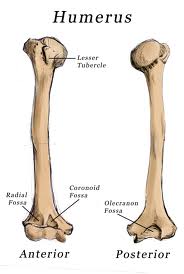
When the arm goes up, the humerus flexes and the scapula upwardly rotates. When the arm comes down, the humerus extends; the scapula downwardly rotates.


Humeral flexion and extension.
The scapular upward rotators and humeral flexors often become weak / don’t work properly; the downward rotators and extensors often become stiff / work too much.
We want to work the upward rotators and flexors, and concurrently limit the work on the downward rotators and extensors. However, we need to methodically do this. If a person has weak legs you don’t immediately throw them in a squat rack with 500 pounds. Not unless you want to cause them a hell of a lot of pain. Same thing for lifting your arms. People can become so poor at lifting their arms where their own bodyweight is analogous to the 500 pound squat. (Their own bodyweight can cause them pain.) Gravity becomes their barbell.
–
Poignant physic / biomechanic concepts
–
Gravity points down (seriously)
It might sound silly, but I’m telling you people forget about gravity, and the fact it points downward, all – the – time.

Fg = mass * the acceleration due to gravity
The acceleration due to gravity is a constant. Everything falls at the same rate. So, the only way we can manipulate the force of gravity is by changing the mass. Greater mass? Greater force. Less mass? Less force.
Quick tangent: Gravity is a load. For the purpose of this post, unloaded will mean in the absence of gravity. I’ve seen many fitness people say things like, “This movement is ok because we’re not loaded. We’re only fighting gravity.” Uh, no. If you want to say unloaded means there’s no added resistance, that’s fine…as long as you say that. But you can’t say a movement is ok because there’s no load, because gravity doesn’t count. It absolutely counts. If it didn’t count people wouldn’t get pain lifting their own body weight.
Said another way: If gravity doesn’t count, why does someone get pain in their shoulder when reaching into the top cabinet? But, they’re fine if someone else lifts their arm for them? (Active raise versus passive raise.) Because in the former situation their arm is doing work; in the latter someone else is doing work for them. The work –against gravity- is causing them pain.
–
Work
Work = Force x Distance
Our shoulder does more work when 1) The force is increased and or 2) The distance the shoulder moves increases. Greater force (such as resistance) or distance = greater work. Less force or distance = less work.
It’s important to note this equation for work is when something is going in a straight line. During an arm raise we’re not only moving up, we’re also moving back.

We’re rotating, and our axis of rotation is the shoulder joint. We need to know the rotational work our arm has to do.
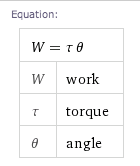
Rotational Work Formula (Credit: WolframAlpha)
Rotational work is directly related to the amount of degrees the arm moves and the torque of the movement. The greater the torque, the greater the work. The greater the distance, the greater the work.
Torque
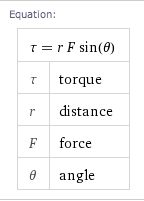
Torque Formula (Credit: WolframAlpha)
Don’t get caught up in the math. The principles of the formula are what we’re concerned with.
Let’s discuss the distance aspect. In torque, the distance is regarding the length of the moment arm. Not the distance the arm travels.
“The distance from the pivot point to the point where the force acts is called the moment arm, and is denoted by ‘r‘.”
For a nice discussion of torque and moment arms see here.
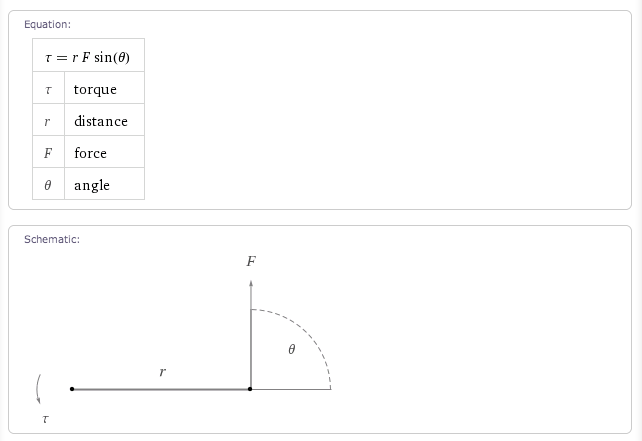
Credit: WolframAlpha
Our shoulder would be the pivot point, and the force acting on our arm -whether gravity or a resistance- is acting at some distance from the shoulder, which is called the moment arm.
The most important takeaway here is: A greater moment arm requires greater torque, and thus work, from our shoulder.
Think of it this way, if you were to hold your arm straight out in front of you,

And someone applied a resistance at your hand,

This is harder…
And then a resistance closer to your shoulder,

…than this.
What would be harder? The resistance at the hand of course. See, you understand moment arms better than you thought.
–
Summing up so far
- People with issues lifting their arms often have an imbalance between the muscles which lift the arm and those which pull the arm down.
- We need to wake up the muscles which lift the arm and calm down the muscles which pull the arm down.
- Gravity points down.
- People with shoulder pain often have trouble resisting gravity due to the workload.
- The work on the shoulder musculature during an arm raise is directly proportional to the torque.
- Torque is directly proportional to the length between the resistance and the shoulder, i.e. the moment arm.
–
An obvious application
Say a person has pain lifting their arm up:

We could reduce the workload on the shoulder by simply bending the arm:


We lessen the workload (and torque) on the arm by reducing the moment arm.


Say you need you reach to a top shelf:
–
Notice how she wanted to naturally bend her arm on the way down? The body already knows how to lessen the workload on itself.
This quick, immediate adjustment, can give pain relief. But let’s take it further. After all, why fight gravity if we don’t need to?
–
Making gravity our friend
By laying a person supine (on their back) and raising the arms overhead -not to the ceiling, but overhead to the floor- we can lessen the workload on the arms even more. Looking at a straight arm, arm raise again:


Instead of gravity fighting the arm raise the entire time, it’s only doing it for half. Gravity is still of course present the entire arm raise, but, now it’s only resisting arm flexion until the mid-point. After the mid-point, gravity is actually helping our arm flexion goal.


We could make this even better by not performing the full motion. Rather than start from extension, we could start at the mid-point.
This way our humeral flexors don’t have to do any active work to get our arms overhead. Gravity does all the work for us.
–
Free fall is ill advised when it comes to your joints
This is where some practical experience comes into play. The only way our muscles aren’t fighting gravity in a supine arm raise is if we let the arms completely free fall. Doing this isn’t a good idea.
1) The hands hit the ground rather hard, but yeah, you could soften the blow with padding.
2) Even though gravity is providing a passive stretch, pain can still be present if the person is really stiff. The muscles work passively too. Some people aren’t going to be able to get to the ground yet. “So, just don’t let them go to the ground then. They can hold themselves up.”
You mean, rather than let the person do this:
Have them do this?

Bringing us to
3) Unless the arms are in free fall then the humeral extensors are working eccentrically to prevent free fall.
Gravity helps the humeral flexors by providing passive flexion. Meaning gravity is doing the work for the humeral flexors. However, unless you’re letting the arms completely relax and fall, then the humeral extensors do turn on.

Think of a push-up. If you take your time going down you’ll feel your chest and shoulders working quite a bit. They’re helping you go slower / preventing free fall as they lengthen.
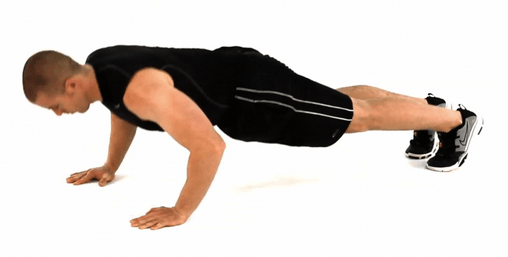
Your arms are pushing into the ground to control how fast you descend. The muscles are eccentrically working. As they are being lengthened, they are contracting.
As I went over in the anatomy section, we want to minimize turning on the humeral extensors as much as possible. While we have a pretty friendly way to get the arms up by generating passive movement into humeral flexion, we can still improve things by turning off the humeral extensors.
–
Slide it up
Start with the elbows bent; keep the hands on the ground (palms facing one another):

Slide them along the ground:


Slide them back to the starting position:
This enables us to
1) Eliminate the force of gravity against the humeral flexors. (Because we’re supine.)
2) Use the force of gravity to help the humeral flexors. As the elbows extend, gravity pushes the arm down. The forces of the elbow extensors and gravity cause our humeral flexion to come along for the ride.

3) By having the knuckles on the ground there is no eccentric work on the humeral extensors. The hands are already touching the ground; the humeral extensors don’t need to be turned on to prevent this; it’s already happened.
4) By sliding the knuckles back in a direction which is down and into the ground, we generate most of the humeral extension through elbow flexion. The humeral extension comes along for the ride.

–
Regressing even further
Not only can we put someone supine to change the affect of gravity, we can put them quadruped.

Then, we can work on our overhead range of motion by rocking backwards:

The difference between this and the supine slide above is, now instead of gravity only pushing the arm down, gravity is helping our overhead range of motion by pushing the entire back down.

The back has greater mass than the arms. Our force of gravity is greater here than in the supine slide, making it easier to get our arms overhead. Gravity has gone from being a friendly coworker to a BFF.
–
Bringing this all together and attaining a progression
In something like the Quadruped Hip Rocking and Supine Arm Raise w/Slide, our muscles which move the arm overhead are doing very little, if any work. Keep in mind though, we still have to overcome the stiffness of the opposing muscles. For instance, many people will, to their surprise, get quite a bit of burning and work out of the slide exercise. Especially when done correctly. (Video of form later.) Because gravity is doing more to help us in the hip rocking than the supine slide, and the hips help pull the body back, the rocking tends to be easier on our arms than the slide.
Once we can lift our arms overhead without having to overcome the force of gravity, we can then bring gravity into play. We can ease our way into things by starting with the arms bent and performing half the range of motion.
Next, we can straighten our arms. Increasing the work by increasing the length of the moment arm.
Then, we can increase our range of motion. By increasing the distance our arm moves we increase the work.
Ranking (least work on shoulders to most)
1) Quadruped Backward Rocking
2) Supine Arm Raise w/Slide
3) Standing Arm Raise @ 90 w/Arms Bent
4) Standing Arm Raise @90 w/Arms Straight
5) Standing Arm Raise @180 w/Arms Straight
–
Videos of our progressions
–
–
–
–
–
Note: I tend to have the person keep their back against something so they make sure they’re not compensating with their lower back.
–
Closing words
There are a ton of ways you can progress between these variations as well. You could manipulate the moment arms further (rather than fully extend the arm, only go half way), you can manipulate reps, sets, add resistance, etc.
Of course, all the ways you can vary adhere to the laws of physics and the math behind it.
–
Shout out to my brother, Chris, who’s studying physics, for help with this.
–
Looking for more help with getting the arms up? Try one of these.


Haig B
September 5, 2013
Amazing how you connect concepts and principles together. Wouldn’t want to learn any other way. Thanks Brian
reddyb
September 5, 2013
You got it. Thanks for the nice comment.
André
March 17, 2014
Great article. Really liked the details about the human mechanics.
Adam T
March 17, 2014
So glad I stumbled upon this article. Been suffering from shoulder pain in lifting my arm for almost 3 months now after a fall while playing ultimate. Doctor suspects impingement or tendonitis. Are your points applicable to my condition?
reddyb
March 17, 2014
Yep. I use this type of progression with people in their 70s who have loads more than some impingement going on :).
The ground stuff tends to be particularly friendly. Another variation I’ll use is have the person lay on their back, arms out, and try to relax from there:
1) Gravity helps do the work for you 2) With the breathing aspect, you help the person try to relax in a position that normally gives them anxiety (arms overhead) 3) You can regress this so it works for pretty much anyone. You can do so by supporting the elbows, some pads or pillows work great, which lessens the stretch. As the person improves, you can lessen the padding until they’re elbows are on the floor.
Adam T
March 18, 2014
Thanks! will definitely try these out 🙂
Sports Therapy 4 Dancers
March 18, 2014
This is great! Thanks for the clear diagrams and videos – incredibly useful. Also a reminder to think about ways of adapting and grading exercises for other parts of the body. Liz.
reddyb
March 18, 2014
You’re very welcome. Happy to hear you got something out of it.
TyWall (@TyWall)
May 22, 2014
Hey Brian! Thanks for the article. I’ve had some major issues with my overhead range and have implemented this in my regimen. There are a few things I’m curious about… Can I do this unilaterally, as in holding one elbow in while extending one arm overhead? When I do both arms at once, I can only get a few degrees down. If I hold my elbow, I get much much further. Also, when I do both arms at once, I fatigue so fast in my anterior shoulder and around my scaps (I’m guessing these are my underworked muscles actually working). I can send you a vid if it helps.
I’ve been going to a circus school the past few weeks and taking a hand balancing course, but my major issue is my overhead position. Because I can’t reach all the way overhead, my body compensates with poor form.
Also, I know you’re not a huge fan of traditional foam rolling, but what do you think about rolling the pecs with a lax ball?
reddyb
May 27, 2014
Hey Ty,
Going with one arm at a time is really a different exercise. You need to be more concerned with what the neck is doing in that scenario. (Video below.)
If by “hold your elbow” you mean using your opposite hand, well, that’s kind of defeating the purpose of the exercise. You want your arm to be able to do the motion without assistance, so it’s best to practice things in this way. The idea isn’t to be overly concerned with how far you go, it’s more how you get there. If you’re going this route my assumption would be you have likely just implemented all the exercises I go over in this, rather than really taken your time and slowly gone through things. E.g. Don’t try the standing version until the supine version is mastered. If you’re stiff, and many are very stiff, just the supine version can take a good amount of time to get down.
The fatigue is a common sensation. Gives you an appreciation for the work these muscles need.
I don’t use lax balls for anything. I’ve played around with them in the past, but have completely phased them out.
nnofes
August 17, 2014
At last I found an answer to the pain in my arm when I lift it. I immediately start doing the exercises and they worked. I am no longer feeling the pain in my arm. THANK YOU!
reddyb
August 17, 2014
That’s great to hear; you’re very welcome.
george
September 3, 2014
Hey Brian,
I started to incorporate these movements in to my daily routine. I just have some questions pertaining to some of the movements and how it should feel. When I do the backward rocking I find it extremely difficult to keep my elbows tucked, similar to the individual in the video (it seems as if at the end of the motion his elbows are pointing out to the side).
When I do the supine arm-raise with hand-slide I have extreme difficulty keeping my elbows tucked and raising my hands at all, especially with the left side Pertaining to this exercise I have a few questions:
1. when doing these exercises should I push to the point of resistance and then return to the starting position or should I hit the point of resistance and slowly try and push past that point. I guess the question is, is it better to do multiple repetitions of reaching the point of resistance or doing more of a slow static stretch?
2. Is it anatomically possible to have your hands completely overhead with elbows facing forward and biceps facing backwards?
3. I feel a huge stretch in my back (lats and especially the teres major/infraspinatus area) It also feels as if it’s accompanied by a major stretch/contraction in my serratus anterior (seems odd) Is this normal?
4. Finally, In the last year or so I noticed that i developed a decent amount of scapular winging (both sides). I also think that the culprit for this was that i for a long long period of time i removed overhead pressing exercises from my routine and heavily focused on overhead pulling and horizontal pulling/pushing. For basically the last nine months I have stopped all resistance training. Every upper body lift I did felt so imbalanced, the muscles on each side of my body did not contract properly or symmetrically. Do you feel that this is likely do to the varying degrees of scapular winging? Also, do you feel that this condition can occur from removing overhead lifting?
Thanks so much,
George
reddyb
September 5, 2014
Hey George,
Re: Backward Rocking- I don’t cue people to keep their elbows in on this. It’s quite uncomfortable due to the palms down hand placement. What you can do is go with a different hand placement:
I’ve messed with this a little in the past and always assumed as a general rule it would be too uncomfortable on people’s wrists. I played around with it again yesterday with a few people and it actually seemed fine. Immediately multiple people went, “Oh, I feel more of a stretch under my arms now.” (Which is what you would expect anatomy wise.) So, maybe I should revisit implementing this!
Re: General form -You should go as far as you can without pain or compensatory form. Everyone has a line. You want to tow this line, but not push past it.
I almost always prefer movement over static holds. People are looking to get better at moving in certain manners. They usually aren’t looking to improve how well they can hold a certain position. I use some static stuff, but sparingly.
Re: Anatomy of shoulder- Yes, it is possible to have your hand completely overhead with elbows facing forward. I don’t believe it’s possible for everyone though. This is where things like acromion type can come into play. For people who after a couple months still have trouble with this, I either tell them to simply not reach past that point, or, if the person is now pain free, to let the elbow turn out those last couple inches. I either avoid that range of motion, or don’t worry about it. Depends on the person.
Re: Sensations- Huge stretch in the lats / under the shoulder is normal.
Feeling a contraction / stretch of the serratus- A contraction of the serratus makes sense but a stretch not really (it’s contracting when bringing the arms forward and overhead). Really, to be able to *feel* your serratus is unusual. You could have some unusual mind-body connection ability going on, or your mind may be playing some tricks on you.
Lastly, scapular winging can cause distortions in how you raise your arms, yes. In terms of removing overhead pressing and winging, that’s plausible. But how you press dictates a lot. I’ve seen some prominent internet authors make the statement that overhead pressing is what keeps the shoulders healthy, balanced, etc. That really, really depends on how the press is being executed.
It’s not like I’d tell someone with shoulder pain to just press overhead more as a corrective modality. 9/10 people I start with can’t lift their arms overhead without compensating somewhere. For your average person, it takes considerable time and effort to be able to lift their arms overhead without resistance. Add a barbell into the mix and most are asking for trouble.
B Miller
October 2, 2014
Thank you! Great article and will help with a client I have. She has no pain, only difficulty raising one arm fully.
reddyb
October 2, 2014
You’re very welcome. Best of luck.
laceyrt
February 26, 2015
I’ve had an issue with my scapula winging for about a year now. I visited various specialists and they all tell me the same thing, physical therapy that always focuses on strengthening my trapezius muscles or serratus anteror. I’ve pretty much stopped lifting my usual regimen and am spending 100% of my time on rehab. I’ve tried the strengthening exercises, I’ve tried stretches and yoga, I’ve tried supplements like magnesium to loosen tight muscles and I don’t know what else to do. I haven’t had a major injury, but I do have a job where I’m required to sit at a desk and work on a computer so I think that at least is partly contributing to it.
Basically what I’m asking is, are these exercises beneficial to someone who is dealing with a winged scapula? And is this normal that I’ve had the winging for so long when I haven’t had a major injury? How long would you say it generally takes to fix (to the extent that it can be fixed) a winged scapula?
Great article, by the way, I really appreciate the detailed info you’ve provided.
reddyb
February 27, 2015
These exercises are good for winging, yes. But, as with all exercise, it’s not just what you do, it’s how you do it. It doesn’t matter what you’re doing if during the exercise your scapula is winging. Or if your scapula is still winging all day.
(I cover this some here: http://b-reddy.org/2013/12/04/a-quick-way-to-work-on-scapular-winging/ )
Article discussing how long it takes to improve things: http://b-reddy.org/2013/08/01/how-long-does-it-take-to-get-rid-of-chronic-pain/
laceyrt
March 2, 2015
Thank you so much for providing the link on a quick way to work on scapular winging, I hadn’t seen this one yet. I’ve been doing this every day for the past 3 days and I can already feel a significant improvement. At this point I’m so frustrated I’ll try anything. Thanks again for taking the time to respond!
reddyb
March 2, 2015
You got it. Happy to help. Hope you continue to find it helpful.
tim
June 3, 2015
Brian,
I simply can’t push overhead with my right arm (military motion) I can’t lift anything in this range….frozen shoulder…Rotator Cuff….Blah Blah….soooo frustrated.
Help!!!!!!
reddyb
June 6, 2015
Well, this article goes into pretty good detail in terms of working on overhead range of motion.
If by military motion you mean an overhead press, that can have some differences. I haven’t written about that type of progression yet.
Danielle
July 7, 2016
Great article. I live in St. Louis and have been given some of these same exercises through the WUSTL PT department. Quick question: What about rib flare and lumbar spine extension? Any tips to keep the ribs down and in while breathing and keeping the lumbar spine neutral?
reddyb
July 8, 2016
You should be in good hands then!
You may have missed this part of the article:
If the lower back stays flat against the surface, then it’s not extending. No need to worry about rib flaring :).
Fab
December 8, 2016
Hi,
You website and this article in particular have been massively helpful!
As i have been increasing my range of motion, i have noticed that at the end of extension in the supine arm raise with hand sliding, my left arm will occasionally “pop” and sort of dislocate slightly accompanied by some mild pain. I have done some research and and found suggestions for working on my rotator cuff muscles.
What do you make of this, and which type of excersizes would you recommend?
-Fab
reddyb
December 9, 2016
Hey Fab,
Thanks for the nice words.
I’d avoid that dislocating sensation. In the supine arm slides, the arms are unlikely to get completely straight overhead without the elbows turning out. No problem- it’s ok to not go all the way, or to only go as far as you can without that dislocating / pain. Meaning I wouldn’t necessarily add a new exercise to address this. I’d instead modify the exercise so it doesn’t happen.