When talking about ankle mobility, the main aspect is always increasing dorsiflexion. 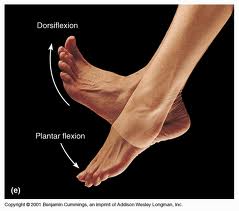
And this is for good reason. Dorsiflexion is one of those movements a lot of people could use more of. Wearing heels or shoes with heel lifts (nearly every shoe people wear) can cause a lack of dorsiflexion. Watch how the achilles tendon gets progressively shorter the greater the heel lift.


Next, people rarely ever put themselves into a position that helps increase dorsiflexion. Think of the difference between you sitting in a chair all day and someone in a toddler squat position (like in cultures that still don’t have chairs).

To make up for this people will try and increase their dorsiflexion and ankle mobility by various ankle rocks, such as:
Sometimes though, you’ll have people do this and they won’t feel restricted in the achilles / calf. They’ll tell you they feel restricted in the front of the ankle. In fact, they may even get some pain or “jamming” there. This is a sign the achilles / calves are not what’s restricting dorsiflexion; it’s the talus. That is, it’s a bone issue; not muscle. 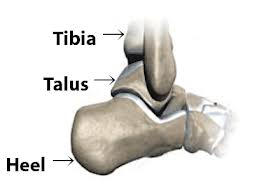 Why does this happen? Let’s go back to footwear. If we look at the foot while it’s in a heel lifted shoe we get this:

Typically with a heel lift a person will have a forward plum line. In other words, they stand and walk around leaning a bit forward.

Therefore, the pressure into their feet is at an angle. For illustration sake, it could look something like this:

The arrows on the left depict the force of having a heel lifted shoe. The arrows on the right depict the forward plum line.
Notice how all the arrows end up with the talus being pushed upwards and forwards. Therefore, the talus ends up jamming into the tibia.
This pressure can push the talus forward. Thus, it’s gliding too far forward and not enough backward. This is very similar to anterior glide issues with the humerus and femur. This is what causes that jamming feeling during the ankle rocks we just talked about. Because the talus bone is sitting too far forward, it jams into the other bones, preventing dorsiflexion. You can do all the rocking you want, but you’re only jamming your bones together. You need to increase the posterior glide of the talus first in order to get anything out of the rocking.
Mobilizing the talus
There are a few ways to do this. The first is a tape technique I learned from the second edition of Movement System Impairment Syndromes. 
For this you use the tape to accentuate posterior glide of the talus. It helps to tape the talus while in a position of dorsiflexion.

Credit to Movement System Impairment Syndromes.
This can be a bit tricky to do; it normally takes a few tape jobs before you get the right feel. It’s also not very comfortable. But it’s a nice way of mobilizing the talus without having to think about it. Tape it and forget it.
Another way to do this is to go through dorsiflexion with a posterior glide on the talus. Normally a towel or rope works well.
(I hope you all enjoyed Tillie’s YEE HAW!)
Then, if you want to start getting a bit fancier you can add this glide to other exercises. For instance, you can anchor the rope; put it around the ankle / talus and go through a step down motion:
This is a bit more “functional.” Of course, if you have a tape job done you’re already doing this. Just another idea.
If you’re having issues with your ankle mobility, give this a shot.


Ryan
September 15, 2013
Thank you for this. There is precious little information about dorsiflexion restriction manifesting as pressure at the front of the ankle. I have been trying for three years to learn what the problem is and how best to fix it. I have succeeded in neither thus far, but my understanding of the ankle has improved leaps and bounds.
Old post, but I will ask anyways: has anyone had success using these techniques to improve there anteriorly-restricted ankle mobility? If I have any luck and I remember, I will let you know.
reddyb
September 16, 2013
Hey Ryan,
I have had people, and know others, who’ve had success using this strategy. However, I’ve worked with very few who’ve had an issue of this type.
As you said though, this seems to be a strongly overlooked aspect of working on the ankle. If you’re having dorsiflexion issues due to something like a “pressure restriction,” this could very well be what you need.
Best of luck!
Michael
February 17, 2014
This helped me immediately (the tape version). I had tried similar things with bands but I just don’t think it was enough force. The fact that the tape does not flex means you get a lot more pressure when you dorsiflex which made a big difference for me.
reddyb
February 17, 2014
Hey Michael,
Thanks for the feedback. I’ve played around with ropes and bungee cords on this too, which seem to be better than a band for the reasons you mention.
Joe
May 2, 2014
Hi Brian, I’m wondering if this actually ends up eliminating the problem of anterior talus glide or do you have to keep using the methods? I have a client with Plantar Fasciitis and I’ve loosened all muscles possibly involved and done ice-dipping, direct ice and postural releases repeatedly to no avail. I checked for this but it doesn’t appear to be the problem either. Thanks bro.
reddyb
May 3, 2014
It’s not going to eliminate things in a day. Typically, the person will employ the method, and then immediately notice a reduction in symptoms. Keep in mind the symptoms we’re talking about here: A jamming in front of the ankle. PF is likely to have other things going on with it. (How they’re moving.)
Joe
May 4, 2014
Thank you.
Johan
May 24, 2014
Hi! How long does it take before i get results with the tape method? I can go into a fairly deep squat with weightlifting shoes (elevated heel) but i need some more to get it perfect.
Also, how tight should the tape-job be? My tape is curling itself when i walk, it turns into a piece of string after a while
Thank you for this article, i have been searching for this problem a long time.
reddyb
May 27, 2014
Depends what you mean by results.
In terms of when should your ankle mobility be improved? Immediately. In terms of when will it be improved so you don’t need the tape or the exercises anymore? Very hard to say. A lot of factors are at play. I have some who, because of their ankle history, because of the footwear and activities they engage in, they do some talus mobilizations everyday. And it’s probably in their best interest to do this forever.
If you’re using the tape but using olympic shoes as well, you’re fighting things from both ends. High heeled shoes can push the talus forward despite the tape being worn.
As a tangent, weightlifting shoes are really more of a 1) Crutch 2) For performance. Unless you’re competing, I have a hard time justifying their use. Last thing people need is more movement with shortened achilles tendons.
Jamie Iames
August 9, 2015
Thank you for the info. Almost one year after rupturing ligament rt side of ankle and just generally badly spraining ankle I still cannot dorsiflex completely and in pain. Changing physical therapists helped as new PT understood at once that ankle was jamming (front/talus) and
gave joint mobilization therapy. It hurt badly but was able to walk better in only one session.
Receiving strengthening exercises, stretching, trigger point therapy, joint manipulation but still have a jamming problem. Tried taping method you show and walked more comfortably.
Believe There is either scarring or inflamed soft tissue that keeps getting irritated when walking. I can not walk very far before foot is very painful. Mri recently just showed inflamed deltoid ligament.
No one, PT, Orthopedist, podiatrist, offers any advice for shoes or taping except to wear a stiff shoe. They are non commital and say just wear what you like. I can walk more comfortably with a heel wedge insert in tennis shoe but afraid I will become dependent and never regain full mobility. Actually don’t know why heel wedge feels better, would think that it would contribute to jamming. Arch is also swollen ,perhaps has a build up of scar tissue.
So, plan to give this taping a try for a couple weeks but should I wear flats or tennis shoes, tennis shoes with heel wedge?
Thank you, Jamie
reddyb
August 11, 2015
Hey Jamie,
Have you seen this? I have a manual all about footwear: http://b-reddy.org/2014/10/30/a-guide-to-footwear-table-of-contents/
I discuss heel lifts quite a bit in there.
Steve
August 20, 2015
Excellent……..I have had dorsiflex issues for 3 years following an injury caused by coming down on a tree that was parallel to the ground….the tree collapsed under weight.
foot was locked for approx 2 months……approx 1.5 years later foot became locked again just from regular use(I am an active runner, trail runner…or I was). 2 months later I was much better again but not back to normal
Had surgery 6 months ago(Feb 2015)…..took out os o trigonum and attempted to shave bone near Achilles insertion.
result of surgery…..surel nerve damage so outside of foot is numb and tingly and my foot has been locked or blocked for 6 months….cannot get past 90 degrees….no dorsiflex when standing straight….worse when knee bent……..calf or Achilles cannot be stretched and I believe neither have anything to do with blocking
….next step surgeon wants to lengthen Achilles and scope front of ankle…….I am being sent for a second opinion.
I have started doing your talus mobility methods on my own from your above article……taping and movement with back pressure on the talus….I have experienced pain relief but not much if any more dorsiflex…..I will continue
can you recommend any physio or other professionals in the Halifax Nova Scotia area that would be familiar with treating this issue…..it seems very unique so the doctors and physio may not have the experience in treating no dorsiflex when it is not caused by Achilles or calf issues….I have been getting physio and massage 2 to 3 times per week plus daily cycling and home physio.
Thank you!
reddyb
August 22, 2015
Hey Steve,
Sorry to hear about the difficulties you’ve been having. Unfortunately I don’t know of anyone in that area. If I come across anyone, I’ll be sure to pass it along.
beemshake
October 20, 2015
Great post, thanks! You’re still getting comments years later because this seems to be the best source of info on improving talar glide on the web.
I have never had great dorsiflexion, but since having debridement surgery to remove a bone spur from the front ankle joint I’ve been having problems with talar glide limiting my dorsiflexion. When I go in for PT, they’ll work on me for 30 minutes and improve my mobility to where I can get maybe 6% (unassisted), but I usually drop back to 4% or less within a day or two. We have utilized both of your methods above (perhaps they too found this post!), and I have certainly improved. We’ve probably done the tape 3-4 times for 2-3 days at a time, and the soleus stretch with talar resistance I’ve been doing at home (with a theraband) 2x/day for 2 minutes each time (say 10 sec stretch and 5s rest, repeats). That said, I still have a ways to go to get back to running without stiffness/soreness in the front of my ankle afterward.
Would you recommend that I keep myself taped at all times? Increase the amount of stretching? I think I tend to have a small amount of fluid in my ankle, would you expect that to block talar glide?
Thanks for any input!
reddyb
October 20, 2015
Hey Beemshake,
Thanks for the nice words.
Fluid can definitely influence range of motion. With the ankle, while I haven’t tested this, I would expect the fluid, particularly considering where you had surgery, to influence your dorsiflexion range of motion more than say, you’re plantarflexion.
If you feel the tape is helpful, it’d be worth playing around with having it on daily. Usually, if someone is having this much trouble, I start looking heavily at footwear as well. Where rather than harping on loosening things up, I start harping on what’s causing things to stiffen?
Hope that’s helpful.
(Thorough look at footwear- http://b-reddy.org/2014/10/30/a-guide-to-footwear-table-of-contents/ )
beemshake
October 20, 2015
Thanks so much for the quick response! Regarding footwear, I’ve been in zero drop shoes for several years. But, I’m 42, so there were a lot of years there where I was not, and I seem to be one of those unlucky sorts who remain stubbornly inflexible despite years of regular stretching. So I have some stuff working against me.
But the lack of talar glide seems to be new since the surgery. Perhaps there’s just some combination of fluid and scar tissue that aren’t ready to let it move well just yet. Hopefully soon, just looking for ways to hasten the process. Thanks!
reddyb
October 22, 2015
If you spent a long time in heel raised shoes, for some, a transition to zero drop shoes can be too much. Where going back a shoe with some heel lift can help give the (quasi)dorsiflexion motion the person needs. Not everyone in the developed world is made for zero drop shoes.
(This is like how olympic weightlifters wear shoes with heel lifts to help them squat deeper. While they have great ankle flexibility, the heel lift allows them motion they wouldn’t otherwise have.)
If the talar glide is / gets solid, and after the years of stretching you’ve done dorsiflexion is still tough, I might play around with some other footwear.
Of course, if you feel good with the shoes you have, then there may be no need to change things.
Nickeva
November 8, 2015
Hello. I wish I had found this website sooner. I haven’t tried the exercises yet, but I surely will today. I suffered a bad sprain playing soccer when I rolled my ankle. It’s has been nearly a year and while I am able to return to regular activities my ankle still aches. My most annoying issue is my inability to completely point my toe. My foot is stuck. Do these exercises assist with plantar flexion as well? I’m am have issue with both dorsal and plantar flexion. Thanks!
reddyb
November 8, 2015
Hey Nickeva,
These are much more aimed at dorsiflexion. You can see some things on plantarflexion here, although I don’t have a post specifically directed towards it: http://b-reddy.org/?s=plantarflexion
You’re also welcome to look at something like this, as regaining plantarflexion strength can sometimes be a little tricky:
http://b-reddy.org/2014/08/04/phone-video-consultations/
http://b-reddy.org/2013/06/20/the-remote-client-process/
Daniel
March 2, 2016
Hello, thank you for this article. I’ve been currently struggling with anterior impingement on my left foot for the longest time which limits my dorsiflexion and prevents me from squatting full range of motion.
I was wondering if you could possibly go more in depth on how to properly tape your talus because I wasn’t too sure if I was doing it correctly.
Also I noticed my impinged foot has a much more swollen Extensor Brevis (I’m not sure if this is the correct area but seems like the general area of the ankle; it kind of looks like a small swollen ball below and slightly in front of the fibula) which might contribute to the impingement. I’m currently experiencing no pain at all except when I try to force my foot into dorsiflexion, then I feel a sharp blockage. I’m really hoping that the tape can be my saving grace. Thanks for your help!
reddyb
March 4, 2016
Hey Daniel,
You want to go just below the crease which occurs when you dorsiflex the ankle. The idea being to push what’s just below that crease down and back.
I typically prefer the other method though. Where you do a few sets of say 15 reps, then go squat and see if it feels better. If it does, you know you’re on the right track.
Have you gotten that swollen area checked out? There could be something, like a cyst, truly blocking motion.
Hope that’s helpful.
Sara
April 6, 2016
Hi there, I love your idea of how we can mobilize a stiff ankle. I was born with a shorter right leg and a smaller right calf muscle. To strengthen my shorter leg and hopefully grow the calf on that leg, I need to do a lot of calf stretches. Unfortunately the ankle from the shorter leg is very stiff. This could be due to me standing mostly on my right foot’s toes in order to compensate for the leg length discrepancy. Just like you explained as if I would be wearing heel lift on that foot all my life and causing my talus bone to stick forward.
Now I was interested to know if I could benefit from a night splinter. Would the splinter help reduce the stiffness and mobilize my ankle? I would appreciate your answer
reddyb
April 8, 2016
I see what you’re getting at. Makes sense to look at it that way.
I haven’t had to have people use a dorsiflexion night splint or sock, but I know many have gotten a lot out using one. Where something like doing the talus exercise right before bed, then putting the splint on, could work very well.
You also want to be on the lookout for other things here, like how heavy are the blankets on your feet. I discuss the sock as well as some sleeping positions in my sleep manual if interested- http://b-reddy.org/2012/08/06/sleep-with-less-pain-tonight/
Devi Piper
June 21, 2016
I do ballet and this strain happened a couple of month ago on a one footed jump landing. The issue persists – never know when it is going to ‘hit’ again. Hurts like nothing I’ve ever felt before when it hits; painful. Just wondering if the taping will eventually resolve it, or if this is something that I will have to “live” with now that it happened. Hate to stop jumping, but have stopped jumping for now.
reddyb
June 23, 2016
Hey Devi,
The talus is a bone, so if you’re talking a muscle strain, this wouldn’t really apply.
Ref Tu
August 2, 2016
Good info.
I wondered why it’s so painful doing front squat as I just can’t bend at the knees due to that jamming feeling.
All that stretche vids in the Youtube didn’t help me so much because all I did was grinding the talus bone.
Thank you.
reddyb
August 2, 2016
You’re welcome.
Try elevating your heels while front squatting. You’ll have more room to descend before placing the ankles into a position where they jam.
beemshake
August 2, 2016
I do this by putting a couple of 5 lbs on the ground where I’m squatting. Works very well.
reddyb
August 4, 2016
There you go!