I wrote a post, The best damn IT band stretch ever, which quickly became one of the more popular articles on this site. I also wrote a stretch for the rectus femoris, A better quad stretch, which is just about the most popular I’ve written. This post will make a lot more sense if you read those two first.
Somebody asked me if there was a standing version of “The best damn it band stretch.” I’ve actually meant to write something about this for a while, so here we go.
There is a standing way to do this, and it’s pretty damn effective. It’s very similar the stretch in A better quad stretch. I typically use the standing version more often than the kneeling version because it’s an easier set-up for people. Especially the clientele I have. (A good amount of older clients, clients who getting up and down off the ground is tough for, clients where kneeling is tough, etc.)
However, I still favor the “best damn IT band stretch.” The primary reason being it’s very hard to know whether the lower back is flat or not in the stretch below. Meanwhile, in the other IT band stretch the person has a bench or table as a feedback tool for knowing where their lower back is. (If it’s not on the bench, it’s not flat.) In anatomy terms, people get greater activation of the external obliques in the “best damn IT band stretch” compared to this one.
Anyways…
First, take your foot and put it up behind you on something. If you’re at the gym, a smith machine works great. If you’re at home, a chair or bed works well. Really, you can do this anywhere. A fence at the park, a bench somewhere, etc.

Next, make sure you have a proper set-up. Some of the most common faults are:
1) Letting the knee flair out to the side.
I wrote about this a ton in The best damn it band stretch ever, so check that out if you want a very thorough anatomy breakdown. Suffice to say, tightness in the TFL is what abducts the femur in this scenario.
So we DON’T want this:

We want the knees to be touching each other. MAKE SURE YOU DO THIS PROPERLY. I have clients who I have to remind of this every single session. If you don’t feel your knees touching each other, you are doing it wrong.
2) Treating this as a quad stretch.
This is NOT the same as pulling your foot behind you and doing your kindergarten “pull your heel to your butt” stretch.
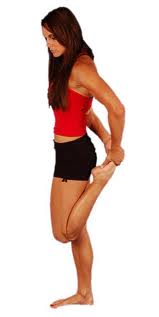
NO NO NO NO NO NO NO NO!!!!!
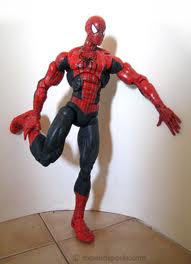
Again, NO! Note how even Spider Man has a tight TFL / IT band.
The way this manifests in this stretch is people always lean back and make their heel touch their butt. You – do – not – want – this. This causes hip flexion, and we are aiming for hip extension. A very crucial distinction. Hip extension means we are fully stretching the tensor fascia latae and rectus femoris.
Do not do this:

Stand nice and tall instead.
3) Letting the lower back arch.
I wrote about this malalignment a ton in A better quad stretch and Thoughts on hamstring curls. Check those for a more comprehensive anatomy discussion. In short, the lumbar spinal erectors and rectus femoris are overpowering the external obliques and glutes. This causes the anterior pelvic tilt and lower back to arch.
This is where it’s important to consider how high you place your foot. The higher it is, the more likely you are to arch your back. For instance, if you look at Holly’s back here you can see this foot position is too high for her:

The foot should be high enough a stretch is generated and it is challenging for the person to pull their stomach in. But, it shouldn’t be so high that keeping the lower back flat becomes impossible.
After you have proper alignment, squeeze your butt on the side where the foot is up. So, if your left foot is up on the bar behind you, squeeze your left butt cheek.
At the same time, make sure you keep pulling your stomach in.
Whenever you stretch the hip flexors it is crucial to have concurrent glute / external oblique activation.
For some of you, you are going to feel a massive stretch down the front of your thigh, if you don’t already. While this is good in the sense it lets you know you are doing the stretch properly, and that you indeed need this stretch, don’t squeeze so hard you begin to debate if you could tear your muscle. That’s too much.
Here is the stretch in full. Notice how Holly has to continually remind herself to pull her stomach in, but when she does, she can do it. Thus, this is just about the right height:
You’ll notice in the video I like to add a little rocking back and forth. This just adds amplitude and allows for some more bang for your buck.
Give it a shot. It’s an awesome stretch for knee and lower back pain. Especially those of you who have knee pain while lunging. Do a few sets of this before your lunges and you’ll likely notice your pain greatly diminish, if not disappear.
***
For more on loosening the IT Band, check out: 6 Exercises to Loosen the IT Band
***


Rich
November 9, 2014
Recently my left foot has been supinating badly when I walk or run. The supination causes me to run unevenly which results in knee pain. My left calf and IT band are tight and I think this tightness may be the cause of the supination. Can the IT band stretch help reduce the tightness and supination?
reddyb
November 12, 2014
The best way to not supinate while walking or running is to not supinate while walking or running. I’d focus on those movements opposed to doing a stretch and hoping it translates.
That said, the IT band stretches you’re referencing embrace supination, so, if anything, they are going to train you to supinate the foot more.
(I’m assuming you read this first. If not, check it out as it covers supination vs pronation and how the IT band factors in. http://b-reddy.org/2012/03/04/the-best-damn-it-band-stretch-ever/ )
nae
February 17, 2015
OMG…you’re a genius! I have a stupid question though. You said don’t hold it, do 4 sets of 15 reps. That means I put my leg up into the correct position on the bar then bring it down…that’s one rep? Put it back up on the bar and down again, that’s the second? etc. etc.??? Love, Love, Love your stuff!!!! That’s the only thing I didn’t understand. SORRY!
reddyb
February 17, 2015
That’s alright. You want to keep the foot up on the bar all 15 reps. The rocking back and forth is where the rep counting comes from.
Thank you for the nice words.
pat
July 21, 2015
hi just a question for you.My right knee has been giving me problems for a while.The pain is below the kneecap to the right. It only bothers me when i run especially when i start off. I run with a straight knee and drag the leg at first. It loosens up after a while and i can start bending it and it feels like there is nothing wrong. When i stand i notice my foot externally rotates but when i run my foot is straight. When not running i can bend my knee with relative ease. The only pain i really get is when i do the kneeling hip flexor stretch which puts pressure on kneecap. Any advice would be appreciated. Have been too many physio’s but to no avail.
Pat
Dublin Ireland
reddyb
July 22, 2015
Hey Pat,
The stretch in this post is typically a beneficial one for knee pain. It may be a nice change for you as well, as you don’t have to be kneeling to do it.
Something else to consider here is perhaps extending your warm-up. Where maybe you are simply a bit stiff when you first start running, considering you feel better after you get into a groove. Getting more warmed up before you start the run may be something to look at.
Have some Jameson for me. Will make it over there one day!
pat
July 23, 2015
Thanks for replying.My knee does not start easing out until I get to around 5 miles or so.My biggest problem is the first few steps. i run like I am side footing a soccer ball(swinging the leg in wards ) and keeping the leg straight.This goes on for a while but also I have got so used to running like this it has become a habit.I was just hoping it’s not cartilage but I was assured by physio’s it could not be because of the range of movement that i have in the knee.I have had similar problems with the same knee down through the years but they went away.
Anyway thanks for replying I appreciate it.I am more of a guinness man myself but if I recover I will have a jameson for you. I was actually on a athletics scholarship in America back in the 90’s.
Cheers
Pat
reddyb
July 25, 2015
Hmm, well having full ROM in the knee doesn’t mean the cartilage is clean. Issues with cartilage doesn’t mean a loss of function either though.
Have you addressed your running technique itself?
I can get onboard with Guinness myself 🙂
pat
July 27, 2015
No I have not addressed my running technique. Any tips of where to start.
Thanks
PS really enjoy reading your articles very interesting.Have taking a lot of the stretches and working them in to my routine.
reddyb
July 28, 2015
I hit on some technique pointers in my 10k manual. May be of use to you: http://b-reddy.org/2014/05/19/6-weeks-to-a-healthy-10k/
And thank you for the nice words. Great to hear you’re enjoying the site.
Bart de Keijzer
July 25, 2015
Dear Reddy,
One major difference that I notice between this stretch and your original (lying-down) IT band stretch, is that here the foot plantarflexes. You explained in the previous article that this is not very desirable, and ideally we want to have dorsiflexion and supination. So what if, instead of lying my foot on the bar, I lie my ankle on the bar, in order to be able to perform the dorsiflexion and supination? Would that not be better?
Cheers,
Bart
reddyb
July 27, 2015
Yep, you could do that. It’s typically desirable to soften the support then i.e. the bar in this case. You can do this with something like a neck pad used for squatting.
Good question!
Janine
July 27, 2015
Can I assume that if my pain is manifesting at the hip rather than knee, that these stretches are still appropriate?
reddyb
July 27, 2015
Hey Janine,
I would definitely not make that assumption. I discuss this a few times in the comments of the original IT band post, here: http://b-reddy.org/2012/03/04/the-best-damn-it-band-stretch-ever/
Dorell
October 4, 2015
Hi Brian. Really enjoying exploring your website and getting a lot from it.
I also have a similar question to Bart, regarding the position of the foot in this exercise as opposed to the lying down version. I don’t have a bar to drape my foot/ankle over (I’m using a chair), so wondered if I could rest my toe on the chair itself to get the same effect.
(I don’t think I have anything at home that is high enough to do the lying down exercise effectively.)
reddyb
October 4, 2015
That’s what I would do. The dorsiflexion is desirable, but in the standing version not always exactly feasible. You can pad the top of the chair, rest your ankle on it rather than toes, and get some dorsiflexion that way. But the padding usually needs to be there, and a decent amount. Otherwise it can be really uncomfortable on the ankle, which can influence the stretch i.e. you want to be able to relax some; not be in pain!
Side note: One clever way I saw someone get the lying version done at home was to lay at the top of a staircase, with their leg hanging down a couple stairs. This worked quite well for them!
reddyb
October 4, 2015
martyficial
August 16, 2016
Hi Brian!
Thanks for the interesting article. I have a question:
Trying out this stretch i got an very sharp pain at the side of the knee. Not really like a stretch but more like a sharp knife-stabbing kind of pain.
Am i doing it wrong? Is it the wrong stretch for me? Or do i just put up with it?
reddyb
October 14, 2016
Hi Martin,
Sorry, looks like I missed this comment.
There are some progressions discussed in the article, such as how high the foot is, how much you pull the stomach in, all of which can increase or decrease the pain around the knee. I would not make the stretch painful though.
The other thing you can do is allow the leg to flare out some (abduction), then slowly over time pull the knee in to where the knees are together.
Pain around the kneecap is a solid sign this is a stretch you want to be working on, but that doesn’t mean the stretch needs to be painful. Some tugging around the knee is often fine. Stabbing, no.
The Birthmark Blog
August 25, 2016
THANK YOU SO MUCH for this info. I’ve been seeing a chiro for a while, and the pain in my TFL and IT band has extended to pain all around my knee and the top of my peroneum longus. I was told my glutes and adductors are weak, so what you’ve written is making sense! The knee pain has gotten so bad that if I sit Indian style for 1 minute, it takes me 20 secs to straighten my leg back out. I was told to do pigeon pose, crescent pose, prying goblet squats and lying glute stretch which now explains why my pain has worsened. I also foam roll.
I have a question about this stretch!!
When I do it to my bad leg, my right leg, I feel a lot of pain below my knee cap and especially on the inner side of my knee. I’m nearly afraid of something tearing. I know I’m seriously a mess there, so is it just those areas stretching? Should I just beat the pain? I feel better afterwards. During this stretch I constantly monitor my posture, obliques, glutes and hips to make sure they are engaged and lined up properly and not shearing in any direction.
reddyb
August 28, 2016
Some tugging around the knee is ok, but it shouldn’t be painful. What you can do then is lessen the stretch. Easiest way to do this is to let the knee open up some outside the hip (abduction), rather than keeping in line with the hip. Over time, you should be able to work on straightening it out.
The Birthmark Blog
September 13, 2016
Great! I have been following this tip for a couple weeks now and the standing stretch is slowly becoming easier to do. Now (most days), I can keep my right leg straight without having to point my knee outward. But my peroneus longus muscle–or at least that vacinity, I’m just guessing it’s peroneals–has still been so sore for 2 months now. My high calve below the backside of my knee is sore as well, and I can’t figure out why and how it could be related to the pain I feel around my knee cap and tender/tightness in many parts of my upper leg, hip and glutes. It seems to have started when I switched to a standing desk, and my strength coach said if I’m putting more weight on one leg than the other, even if it’s slight, it can really create imbalances. How might I get rid of this pain, stiffness and soreness in my right peroneals? I’m 29 and fit and I can’t even sit Indian style anymore bc of it.
reddyb
September 16, 2016
Anything radiating around the leg like that and the lower back needs to be carefully considered as the source of issues. Example- https://b-reddy.org/2013/09/09/some-quick-notes-on-piriformis-syndrome/
Indian style can be a hard position on the lower back because the back will likely have to be flexed. It depends on the person, but in someone with a sensitive back, which you shound to have, it wouldn’t surprise me if that’s why Indian style doesn’t feel great.
There are ways to make this type of sitting more comfortable, but tough to discuss in a comment. Wrote a note to myself to write an article about this, as I’ve been surprised how many mention having issues with this type of sitting. Didn’t realize so many non-toddlers were doing it :).
The Birthmark Blog
September 16, 2016
Oh please write an article on this!!! And hopefully this provides more insight to the issue:
I sit Indian style with a straight back for yoga positions :). It doesn’t hurt while sitting; it’s when I come out of it. the pain also happens when coming out of hip opener positions. Anything where my knee is bent and flared out. When I come out of these positions and to straighten my leg I’ll suddenly have soooo much deep pain in my knee (mainly the bottom), in my peroneus longus and in the backside of my calf near the hammie… it can sometimes take me 30 seconds to straighten my leg. It’s like it freezes. I can also sometimes trigger the peroneal pain when trigger pointing my glute medius. I have no ankle pain but my ankles collapse a bit.
I’m so confused. I’ve heard some pros say stretching helps heal tightness and adhesions and others say do not stretch until you’ve broken up the adhesions. (I use Dr Kelly Starlett’s mobilization methods). Yoga and Starlett’s methods work great for a few hours (and are time consuming and oh so painful to do), but long term, I’m just not gaining any ground. In fact I’m not sure if it’s doing more harm than good. I’m afraid to weightlift anymore for fear of creating more adhesions. I did bodyweight squats last night with super focus on form, and yet my right glute, hip and IT band are jacked up today. I have leg weaknesses, so I feel i have to keep up with my exercises…but I also feel exercise is adding to the pain. It’s interesting that I weightlifting for two years and when I slowed way down and pretty much stopped is when these issues crept in and now have become debilitating.
reddyb
September 18, 2016
Since you read the foam rolling article already you might want to check it out again. There is a section in there about scar tissue which is relevant to what you’re asking about adhesions.
John Perkins
September 10, 2016
FYI: the IT band is not a muscle (rather an extension of connective tissue off tfl and glut max) so therefore cannot be stretched, only mobilized.
reddyb
September 13, 2016
Hey John,
From here: https://b-reddy.org/2012/03/04/the-best-damn-it-band-stretch-ever/
Not sure how you’re deducing connective tissue can’t be stretched? Feel free to elaborate.
Brandon
August 14, 2017
Hi, I’m a high school cross country runner and I’ve been “injured” just about every summer (patellofemoral, itbs). Just recently I went to the doctor for shin pain and was told I had weak hips. I’ve been doing the exercises, clams, monster walks, quad stretch with foot propped up behind instead of holding, and itb stretch laying down and pulled across body with a towel. I have no more shin pain but I can feel my itb rolling over when I bend my knee. It’s not exactly painful, yet, but it’s very uncomfortable and annoying. Also directly above my knee if I feel it while I bend it it feels like something catches and pops there too, also nonpainful. I’m going into senior year and I would really appreciate some advice on taking care of this and if this exercise among many others I’ve researched would do me some good.
b-reddy
August 15, 2017
Hey Brandon,
Sorry to hear about your continued injuries. The first thing I do in a situation like that is loosen up the IT band in various ways. The standing stretch in this post is one method, but I also have a manual with some more variety here: https://b-reddy.org/2013/08/20/6-exercises-to-loosen-the-it-band/
That said, some gliding of the IT band, getting some cracks or pops in the knee, is often nothing to worry about. Can be simply part of the body moving around. If it’s *regularly* painful, then that means it is something to worry about. However, just because something has started does not mean it will become painful. A random painful crack here and there doesn’t necessarily mean you’re on the path towards regular pain either. (If you know anybody who likes to crack their knuckles, they’ll tell you every now and then they do it and it’s painful.)
From your injury history, the tissues around the knee may have changed some where sounds are now more likely. This is a technical post, but I talk about this more here: https://b-reddy.org/2014/07/14/whats-up-with-the-noise-my-knee-makes/
The last thing I’d mention is to be very mindful of how quickly you ramp up your mileage. One of the tough aspects of high school sports is a large group of athletes tend to get treated like a group rather than individuals. It’s customary for a group to have the same runs, same increases in mileage, same amount of days off, etc. You may need to ramp up more slowly, or need more rest days, whether it be from your injury history or due to inherent differences in how you respond to training. Talk about this more in this post: https://b-reddy.org/2016/10/24/the-variables-and-an-equation-to-consider-when-starting-a-physical-activity/
Brandon
August 15, 2017
I’ll definitely look into those links. Today the rubbing on the outside of my knee was painful/uncomfortable enough to cut my run to about a third. My coaches thoughts are that since I used to be a wrestler I have a much more muscular build than the majority of my team and maybe I need to stretch more. Also, my doctor had give me me a kneeling tensor fascia latae stretch and a standing rectus femoris stretch with the foot propped up behind. I’ve noticed that both of these have alleviated the pain on my shins but they feel as if they’re straining whatever is distill to the patella and wanted to know if maybe these exercises could have contributed. (Sorry if this is throwing a lot at you, but thanks for the help)
b-reddy
August 18, 2017
The rectus femoris and IT band connect into the patella. If they’re stiff, pulling on them can cause irritation around the patella. Where one has to be careful about trying to stretch them too much, too soon.
Thomas Namara
October 15, 2017
Hey Brian, I just did the standing version of this stretch, and afterwards I felt the most intense pain just from taking a few steps. Is that normal?
I have been dealing with ITBS for the last two weeks. I’m a pretty serious runner at the collegiate level (60 mpw), and I am trying to lose this injury. I had it before when I was a senior in high school 3 years ago, so I understand a little bit about the biomechanics behind it.
By the way, it’s probably worth mentioning that I have pretty flat feet and I have been running with a neutral shoe. Although, I have been running in a neutral shoe pretty much since March and only now am I experiencing the probable symptoms of possibly the lack of support. My femurs also tend to roll inward, which I have been told can be an issue.
b-reddy
October 17, 2017
Hey Thomas,
If you feel pain during the stretch, you want to abduct (let your thigh move laterally) enough to where you don’t feel pain.
Knee pain during, or immediately after this stretch, is a sign of 1) Indeed there is some stiffness 2) Stretching too intensely.
You want to give in to that stiffness some, progressively increasing the stretch over time. By time, we mean potentially a month or two.
You may be interested in: https://b-reddy.org/2013/08/20/6-exercises-to-loosen-the-it-band/
The internal rotation of the femurs while running can also be a problem. While loosening the IT band can help, that often necessitates focus on running technique (https://b-reddy.org/2013/06/20/the-remote-client-process/) .