From A Better Quad Stretch:
“This isn’t a great stretch for those with hip pain. Form becomes absolutely crucial and you’re honestly just playing with fire if you have hip issues and you do this stretch.”
From Standing Version of the Best Damn IT Band Stretch:
“Whenever you stretch the hip flexors it is crucial to have concurrent glute / external oblique activation. “
I’ve gotten a lot of questions about this. Let’s delve in.
Two themes:
1) Having hip pain / issues does NOT = let me stretch the ever-loving-hell out of my hip flexors. I am so tired of people assuming every damn issue in the body is from tight hip flexors. HEY T-NATION.COM, I’M TALKING TO YOU. THANK YOU FOR MAKING THE WORLD A WORSER PLACE.
I need a drink.
And 2) Other muscles are important if you do stretch the hip flexors.
Why people get hip pain
While hip pain issues arise from a few factors, there are two causes I overwhelmingly see:
1) The issue is actually from the lower back. This typically (but not always) manifests in the back of the hip. Think nerve issues like sciatica.
2) The issue is truly at the hip. This manifests more in the front / side of the hip with sensations like snapping or pinching feelings.
This will deal with 2). Why does 2) happen?
It’s nearly always because the hip is constantly held in extension. In standing the person’s posture would be as such:

See how the knees and feet are behind the hips? Just like if you were to pull your leg behind you. This is HIP EXTENSION.
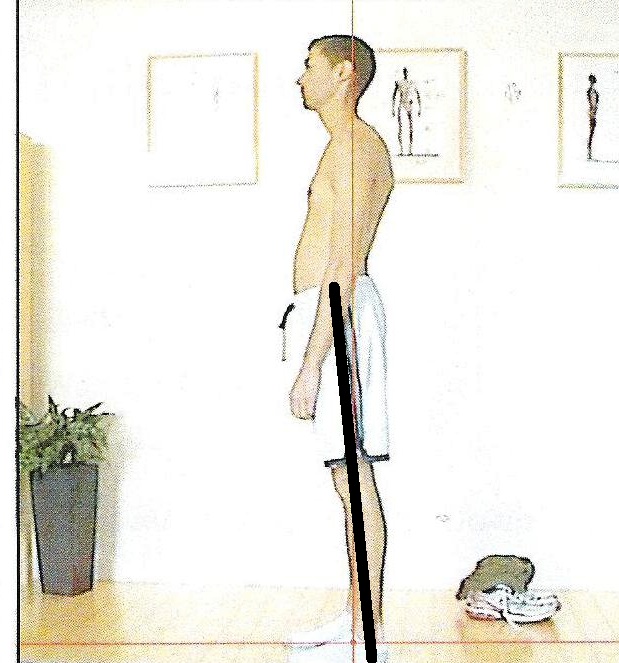
What happens here is the head of the femur is constantly pushing forward on the front of the hip capsule. (Femoral anterior glide.) Bottom of the leg goes backwards => top of the leg goes forward. Similar to a lever.


But you decry, “I sit all day! My hips are always flexed! I need to stretch my hip flexors.”
Sitting can cause the same issue with the femoral head as always standing with the hips in extension. Because the majority of people’s weight is on their ass when they sit, this is where the majority of gravity is pushing. Pictures will illustrate this better. The femoral head is where your ass is.

Rotate the diagram and:

Again, notice the femoral head is being pushed forward all the time.
Next, let’s compare some of these positions with the ways most stretch their hip flexors.
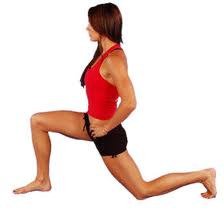

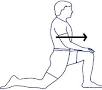
You should be starting to see too many similarities…
Some anatomy
So if a person’s hip pain is caused this way, which it very often is (if it’s not it’s probably from the lower back), their hips are often in extension / the femoral head is always being pushed forward. Therefore, the hip flexors, namely the psoas, is often long / underused / weak and the hip extensors, namely the adductor magnus and hamstrings, are tight / stiff / overused.
Hip often in extension / femoral head always being pushed forward = hip flexor(s) are likely LONG and hip extensor(s) are likely SHORT / STIFF.
Unfortunately, this does get more complicated. Because not all the hip extensors are overused. The glute max and posterior gluteus medius are typically not working as well as they should. Because they attach to the head of the femur and pull it backwards, you can see how if these muscles aren’t working well the head of the femur glides too far forward.

View from the back of the legs. Glute max and glute med can pull the leg backwards. (Hip extensors.)
-> More details on the glutes: Rethinking how and why you’re training your glutes
Despite what T-Nation would have you believe, anatomy and movement isn’t as simple as all hip flexors are short so all hip extensors are weak, or vice versa.
An example: Take someone with hip issues and have them perform a prone straight leg raise:
You’ll typically see the hamstrings and adductor magnus overwhelmingly perform the movement. They will contract way harder and way before the glute max ever does, despite all the muscles being hip extensors. If you can’t see it, placing one finger on the glute with another on the hamstrings usually gets the point across: you often feel the finger touching the hamstrings get pushed into well before the finger touching the glute does.
Quick summary so far
Hip pain issues are very often due to the hips being in extension. This elongates the psoas muscle and often the glute max and posterior gluteus medius are not working optimally (they contract too late / not at all).
Back to the typical way people purport you should stretch for hip pain:
What is this stretch doing? It’s putting the hip into extension without contraction from the glutes, and it is elongating the psoas. In other words, it is doing all the things that typically cause hip pain!
Why on earth would we do this stretch for someone with hip pain? We’re putting them into the same exact position which is causing them pain!

-> Many people who have hip pain walking have the pain when their leg swings behind them. This is why: Relieving hip pain while walking
Again, not everyone on earth has an anterior pelvic tilt or tight hip flexors. (Eh em, T-Nation and internet gurus).
In fact, the stretch that will be best for someone with hip pain is almost always a hip extensor stretch. Like the Backward Rocking stretch:
Why? Because the hips are in extension / the femoral head is pushing forward all the time; do the opposite i.e. put the hips into full flexion and push the femoral head backwards, and wa-lah, pain relief.
Furthermore, if someone has a hip history, you can see, if the hip is placed into extension, it is crucial the glutes be contracted to help pull the femoral head BACKwards. Doing any type of direct hip flexor stretching for people with a hip history is often a bad idea though. At least until their symptoms calm down.
This is crucial because someone like Dan (pictured above) figured out he had issues with his TFL, however, the last thing he wants to do is a bunch of stretching for the TFL where he is putting his hip into more extension. After all, his hips’ natural position is already extension. He especially doesn’t want to be doing this if his glutes are not concurrently contracted. He has to attack loosening his TFL from a different manner.


Jennifer A Thompson
October 9, 2013
Do you have any suggestions for how you can sit to avoid the forward pressure on the femur? I’ve started having some discomfort on my right side during max hip flexor extension (stretches you show) and flexion (pulling knee all the way to chest) and while sitting (of course I have a desk job).
The past few months I’ve been very conscious about sitting up straight at my desk to try to correct rounded shoulders. I suspect this is putting more pressure on my hip.
Oddly enough, it feels fine with most of the activities I participate in, but rowing machine aggravates it (when returning to starting position when knees are to chest). I’d appreciate any advice!
Jennifer
reddyb
October 10, 2013
-I wouldn’t stretch your hip into maximal hip extension, especially if it’s painful.
-You want to make sure the knees are the same height / a little above the hips. If they are above the hips, you have to also make sure the lower back is not rounded. Having the hip in a little bit of flexion (knees above hips) will help keep the psoas a bit shorter, but, you need to also make sure the lower back is erect so the psoas doesn’t lengthen from the lower back connection.
-Softer surface > harder surface.
-Try to sit on your ischial tuberosities rather than your femurs. This is hard to describe as I don’t have anything thorough written yet. But a google image search should help elucidate.
-Sit less; stand more. I’m strongly partial to standing cardio modalities versus sitting. For example, elliptical versus rowing machine.
-More sitting considerations here: http://b-reddy.org/2013/01/27/cycling-clicking-sitting-and-knee-pain/
-More on hip pain:
http://b-reddy.org/2012/09/03/my-visit-to-the-washington-university-in-st-louis-physical-therapy-program/
http://b-reddy.org/2013/07/21/looking-at-pelvic-tilts-the-hips-only-tell-you-part-of-the-story-an-anterior-pelvic-tilt-doesnt-mean-your-hips-are-flexed/
Andre
October 30, 2013
Hey Brian, your advice will be greatly appreciated. I’ve been having right anterior hip pain for over a year now. The pain only occurs when I do weighted leg exercises that require full hip flexion and extension. Exercises like squats, leg press, hack squats, lunges, etc cause pain when I go deep (past parallel). Deadlifts also cause pain at the top of the movement when I’m in full hip extension. Sometimes even when I’m doing a lot of reps of body weight squats, I start feeling this pinching pain during the exercise when I go into flexion and it gets worse the more reps I do.I have been foam rolling my groin, stretching, icing, acupuncture, but nothing seems to help. I also put a tennis ball on my psoas muscle and just lie on it for 5-10 minutes. Sometimes stretching my hip flexor brings the pain back. What do you think is causing the pain? I thought I had hip tendinitis, but I stopped weight training my lower body for 5 months. The first day I went back to squat with only the bar and the pain came back after a couple of reps. I went to two doctors. One said I have hip tendinitis and the other one said to take a ct scan. The ct scan came out clean. It’s really frustrating not knowing whats causing the pain. Thank you for your time.
reddyb
October 31, 2013
Foam rolling won’t help this. More here if interested: http://b-reddy.org/2013/05/20/issues-with-foam-rolling/
You sound like a pretty typical femoral anterior glide case. Some more here: http://b-reddy.org/2012/09/03/my-visit-to-the-washington-university-in-st-louis-physical-therapy-program/
Loosening / releasing the psoas is probably a bad idea: http://b-reddy.org/2013/07/21/looking-at-pelvic-tilts-the-hips-only-tell-you-part-of-the-story-an-anterior-pelvic-tilt-doesnt-mean-your-hips-are-flexed/
If interested, I can take a closer look at you and see if I can help you out remotely: http://b-reddy.org/2013/06/20/the-remote-client-process/
Joe D
November 1, 2013
Andre,
I had very similar issues post (hip) labral tear surgery. And I incorporated some of Brian’s ideas into my PT and it helped a lot. Don’t stretch that hip flexor, even though it seems like it makes sense to. Object is to get the head of the femur back into the hip socket.
Aside from that, did you have an MRI (or MRI Arthrogram) to see if you have a torn labrum? The CT scan is not the normal diagnostic test used (its used after to see if you have FAI).
Good luck,
Joe D
reddyb
November 1, 2013
Thank you for chiming in Joe.
Andre
November 10, 2013
Thank you Joe and Brian. Sorry for the late reply. I want to get a mri, but my insurance doesn’t cover it and it’s expensive. So I’m hoping it’s just an anterior femoral glide and not a torn labrum.
I just have a few more questions. Are hip thrusts, pull throughs, rack pulls with strong glute action during concentric, and the hip abduction machine good exercises for strengthen the glutes and fixing this problem? Also, should I stop all squats and the other exercises that cause pain, and just focus on these exercises too strengthen my glutes to pull back my femur? And how long do you think I would need to do this to fix anterior femoral glide? Or should I just do a couple of these exercises for glute activation as a warmup before doing squats and leg press, lunges, etc. Thank you.
reddyb
November 12, 2013
-You could have anterior glide issues and a torn labrum. Doesn’t mean you need surgery though.
-Those aren’t good exercises. With hip extension, such as thrusting and pull throughs, it’s more the timing of the glutes firing than it is their absolute strength. Those exercises are much more strength oriented. What you need isn’t a huge emphasis on hip extension -in fact you need more of an emphasis on getting the hips back into flexion- and with hip extension an emphasis on proper hip extension. Such as being sure the glutes fire first and there is no compensatory movement. Working on the Bird Dog is one way of doing this: http://b-reddy.org/2013/02/27/proper-form-for-the-bird-dog-exercise/
-In terms of how long things take, that depends:
http://b-reddy.org/2013/08/01/how-long-does-it-take-to-get-rid-of-chronic-pain/
http://b-reddy.org/2013/06/20/how-many-reps-and-sets-to-correct-muscular-imbalances/
-Anything that causes pain should either be modified to not cause pain or eliminated in the interim. You don’t get out of pain by going through pain.
-Glute activation exercises, at least those commonly found on the internet, aren’t going to help. It’s not a matter of activating the glutes, it’s more of a matter of when the glutes activate. It’s when they turn on, not whether they turn on.
-I’d give the Washington University post a good read through. A lot of things are covered in there, including a couple specific exercises.
-An easy way to leg press without pain is to place your thumb on the anterior hip, right where the femoral head would be. So, your thumb is between your femur and pelvis, that crease that happens as you bring your knee into your chest. Now, as you bring the sled down (knees into chest) keep some pressure on the femoral head with the thumb. This helps to promote posterior glide of the femoral head. That usually will give some, if not all, pain relief. Of course, that’s if anterior glide is truly the issue, which I’m guessing at a bit here.
Hope that helps.
Joe Danna
November 18, 2013
Brian, I’ve read most of your posts here and I’m fully grateful for such 3-D education. I’m a MT who began at The School of Healing Arts over in your neck of the woods way back in 1991.
To the point. Would you help me to understand what happens to the hip when someone wears a foot cast? I have a client who broke her foot and wore a cast for 8-weeks. That was a year ago. The first time I worked on her she felt better, but afterwards it was all down hill. Didn’t see her for a year. She’s been in PT. The left side/hip is affected. She came back today and with these developments:
1. Can barely flex left hip at all. Like it’s not firing or is just too weak. Very trying to stand from sitting.
2. Her gait is so off balance she rocks laterally and appears to throw her left leg forward.
3. Bilateral muscular pain from proximal quads to knees.
4. Bilateral anterior pelvic tilt is even at around 20 degrees.
5. Has had MRIs to hip and lumbar. Had nerve conduction tests. All normal.
6. Tight adductors and glutes, quads.
I certainly will check her hip alignment closer when she comes in next week. I hope you can give me some basic ideas without seeing her.
Thank you sincerely, Joe Danna
reddyb
November 20, 2013
Hey Joe,
Nice to meet you. Thanks for the nice words.
Have you read this post regarding ankle push-off and hip issues? http://b-reddy.org/2013/06/13/relieving-hip-pain-while-walking/
I haven’t worked with many who’ve been casted up for that long, but I’ve seen enough of them in conjunction with ankle sprains that this is what I often see:
Because the cast / sprain prevents the person from really using their plantarflexors, that is, pushing off from their foot, they end up doing work more from the hip. Not only more work, but faulty work. Such as rocking the body or swinging the leg around so the cast clears the ground. In fact, if the cast is big enough, that will give them an artificial leg length discrepancy causing asymmetric hip heights.
The post I linked goes over how this relates to hip issues pretty extensively. That post in conjunction with this post should give you some understanding of why her hip flexion is limited.
At first glance my idea is she got used to walking a certain way while being in the cast. This faulty gait continued to cement after the bone was healed but the surrounding musculature was still atrophied. After a few months of walking like this it became her default way of walking.
This is a common thing in those who suffer a traumatic injury: The initial injury heals but the compensations acquired do not go away unless you train them to. Basically, she needs to learn how to walk again. Of course, easier said than done. And, that doesn’t mean particular exercises aren’t beneficial. Such as working plantarflexion directly. It’s feasible certain muscles aren’t yet strong enough for her body to walk in a proper manner. That is, her own bodyweight could be too much resistance for her calf muscles, amongst other things.
But, you can’t expect to do some manual therapy or some exercises and for that directly change her walking. She needs to work on her actual walking as well.
Hopefully that’ll give you some direction.
Joe Danna
November 20, 2013
Yes Brian I did read about the walking and in fact sent it to her with added layman explanation. The first thing I told her was to stop kneeling lunges and thoroughly explained why. She also got the videos for the prone straight-leg raise and more. I told her to take it slowly/carefully as she is so weak.
All I can say is thank you for opening my eyes to things I never had access to before. Not in such a direct manner anyway. I’m very happy (gratified) to learn these things. Not always easy but it gets easier because of my interest and focus.
Today I had a young lady client with a flat spine and degen disk disease. She gets right lumbar QL area pain. All I knew to do was to smooth out her laminar groove to decompress the vertebra and traction by pulling her feet/legs inferiorly. Worked QLs some because it gives her lengthy temporary relief.
Will check your link.
Thanks sincerely, Joe
reddyb
November 21, 2013
If she is really weak an approach I like to use is implementing a few different low level exercises to simulate walking as closely as possible. For example, I may use quadruped hip extension, a hip flexion drill, and some heel raises.
https://www.youtube.com/watch?v=iZXpKlIt9h0
https://www.youtube.com/watch?v=BNXfRAH8xIg
https://www.youtube.com/watch?v=l_E3CbS3g_0
(There’s a video link in the middle there which isn’t embedding for some reason.)
This way the person has some hip flexion, hip extension, and plantarflexion, all movements part of walking. (All the above are hip friendly as well.) With the low level exercises though you can separate a complex movement, walking, into simpler movements. Once these are being done efficiently you can move on to loading the person a bit. Say some small step-ups, box squatting, etc.
It’s only a matter of time before the person is sufficiently strong enough. At which point then it’s time to really hammer on how they are walking i.e. integrating things. (Easier said than done.) When that transition occurs is tough to say. Although, you really don’t need to be that strong in order to walk well.
Hopefully that makes sense.
Thanks for the nice words. Glad you’re getting something out of things here.
And thank you for the donation! Very much appreciated.
Joe Danna
November 27, 2013
Brian. Please check this link from “MedHelp”. Most of these folks posts are exactly the same as my client. I saw her Monday and noticed she has tight upper adductors (very tender) bilaterally. She does have tight TFLs too. She’s doing all the exercises we discussed. She was about 60% improved after Monday’s session but it didn’t hold up and Tuesday she was back where we started. Hope it’s OK to share this link here. Thank you: http://www.medhelp.org/posts/Womens-Health/difficulty-getting-up-and-walking-after-sitting/show/31606
reddyb
December 2, 2013
Hey Joe,
-I wouldn’t be surprised if many of those people are simply weak and moving poorly. As some of the posters alluded to, some could certainly have other issues, but I’m betting getting stronger would help a lot of them. This type of stuff is hard without seeing the person.
-Keep in mind tenderness isn’t necessarily a good sign for tightness. A muscle which is excessively lengthened can also be very tender.
If you haven’t read this yet, more here: http://b-reddy.org/2011/07/21/just-because-it-feels-tight-doesnt-mean-it-is/
-If she was improved after the exercises that’s usually a sign you’re on the right track. Now you need more time and consistency for things to stick. You can’t expect a whole to hold in less than 24 hours.
Joe Danna
December 2, 2013
Thanks buddy. Good info, but the results didn’t come from the exercises (not that they aren’t of benefit). When she came in for her session she could hardly stand from a sitting position and had jolting pains down the front of her quads on movement only.
I didn’t stretch her quads, but got some good circulation going. Then I accessed her left psoas, which was painful to the touch (she wore the boot cast on left foot). I carefully pinned and stretched it by having her push her heel inferiorly after some static pressure and frictioning…something I rarely do because I’m not crazy about the abdominal aorta among other things lurking in there, but I was very careful. I also stretched her TFLs because she doesn’t appear to have hip extension. Her right psoas was minimally worked and much less irritable.
After the session she could stand easily and had no pain. It just didn’t last until the next day. So does the fact she ONLY gets the “jolting” pains down her quads with movement likely signify a muscular weakness?
This all began when she sat on a stool with her leg folded up under her ass while on a 2 hour conference call. At the end of the call, she went to walk on her sleeping leg and fell on the floor breaking a bone in her foot; thus the boot cast. I know it’s complicated without seeing her. You’ve been a great help and thanks so much. Today she had an appointment with her PCP because the pain is worsening. He will likely give her pain pills, which of course, won’t get to the root of her problem.
reddyb
December 4, 2013
Hey Joe,
I’m really not sure, especially without seeing her. “Jolting” pains down the quads is not something I see too often. My first inclination would be to look at her back rather than her legs. It sounds like she’s having nerve issues, and that’s where those anterior nerves (femoral) start (her back).
Joe Danna
December 4, 2013
Yes from upper lumbar. But what threw me is that her MRI came back negative. I’ll keep you posted. Thanks again.
Joe Danna
December 2, 2013
I forgot to mention that if she comes back I’m going to check her pubis symphysis since the boot cast tipped her pelvis.
Justin Archer (@ThePostureGuy)
December 6, 2013
Great post! The visuals helped explain FAI to a client of mine. Have you tried using resistance bands (a la Kelly Starrett/Mobility WOD) in-conjunction with self joint mobilization movements/techniques? I have and they seem to be quite effective, but I’d be interested to hear your opinion. Happy Holidays!
P.S. My wife and I use to live in SD and go to Escondido regularly. We love it there! I’ll definitely look you up next time we’re in town.
reddyb
December 7, 2013
Hey Justin,
Nice to meet you. Feel free to hit me up next time you’re in the area.
I don’t use resistance bands with this type of stuff. In terms of corrective exercise, I do my best to use no equipment as it lessens the barrier to execution. The more stuff people need, the easier it is for them to not do it / have an excuse. “Oh, I don’t have that.” At the same token, the less people need, the easier it is for them to do it. Traveling? No problem. Bad weather can’t get to the gym? Doesn’t matter.
The only band variation I’m aware of in relation to this stretch is where the band is pulling the hip even more forward. Where the band is looped around the femur close to the femoral head, pulling the femoral head anteriorly. (I googled “Kelly Starrett band hip flexors and this is what popped up. This is also a stretch other people have asked me about.)
In this post I outline how you don’t want to promote anterior translation of the femoral head. So, in the context of this post, that version of the stretch is making a bad stretch even worse.
In the context of hip pathology, the anterior structures of the hip are usually where issues are, such as labrum tears. Embracing a stretch of this nature exemplifies a pretty good deal of misunderstanding as to what is appropriate exercise for the hip.
In the context of Kelly’s methodology, in the video I saw he emphasizes arching the lower back and bending it to elicit a greater stretch. This exemplifies a misunderstanding as to how the spine is structured and what causes lower back pathology. After doing this he emphatically states, “We’re going to really try to tear open this high hip.” Then he asks the demonstrator, “How’s that feel? Like what? Tearing?! CHECK! TEARING IS GOOD! In most situations.”
Compound this with the fact he’s associated with CrossFit and…
I recently had a birthday and I’m trying to calm down in my hopefully wiser years. Rather than go on a rant I’ll state I didn’t link to his site for a reason, and this is the type of thinking that 1) Gives the fitness industry a negative light and 2) Really does a disservice to people.
Andre
December 11, 2013
Hey Brian, I’ve been doing the glute exercises that you have recommended for anterior femoral glide syndrome. I also wanted to ask you what muscles I should be foam rolling and stretching. I know I shouldn’t foam roll or stretch the hip flexors, but is it a good idea to foam roll and stretch the hamstrings since they’re over active and doing all the work that the glutes should be doing? Should I also foam roll and stretch the glutes, it band or erectors? I’ve been doing the backward rocking stretch and I don’t feel like its helping much. The exercises that I feel a little bit of difference in are the hip thrust and the bird dog. I also started doing another exercise called the fire hydrant where you’re in the same position as in the bird dog, but instead of lifting your leg backwards, you lift your leg to the side.
reddyb
December 12, 2013
Hey Andre,
Foam rolling is covered in the link I sent you in my other reply. Hamstrings, flutes, IT band, all is covered.
The Backward Rocking exercise isn’t meant for the person to feel much. It’s a passive way of loosening the hips up. It should feel easy.
Andre
December 11, 2013
I just read your comment about Kelly Starrett above. What about if the band is set where it’s pulling the femur bone back or to the side?
http://www.youtube.com/watch?v=SE-yVP691SA
reddyb
December 12, 2013
Those are better than the other example.
Per my remarks in that comment though, I don’t use bands. Per my earlier comment to you, you could achieve a very similar effect by using your thumb to push the femoral head.
Nick
January 5, 2014
Hello reddyb,
I’ve only just come across your site and it is a fantastic resource for those of us in hip pain. I have a query if I may. About 8years ago I got pain at the bottom of a barbell back squat in the front of the hip capsule, que much farting around attempting to work out what was going on and about 18months ago I was diagnosed with FAI by an MRI, showing minor damage to labrum and some wear on femur and socket (right hip.) They were keen to operate but I see it as an absolute last resort.
Now I’ve accepted I should not squat or at least be very careful and I’m now trying to change my training to accommodate this. I’ve worked with countless specialists and its upsetting to think of the money wasted! One thing I’ve never been able to understand or have someone explain to me is why my right hip appears to be stuck in hike? In the past a manual therapist commented that my femur was jammed right up in the socket on that side and she coaxed it out somewhat. However over time it seems to have gone right back up there, have you ever seen or heard of this before?
I worked with some gait specialists who felt my lack of pronation was contributing to this but my work with them didn’t appear to change this for me.
I’d be extremely interested in your comments.
Kind regards,
Nick
reddyb
January 6, 2014
Hey Nick,
First, kudos to you on seeing surgery as an absolute last resort. This is a philosophy which should be more prevalent!
Are you saying you feel your right hip is hiked up? It sounds like you’re talking about a lateral pelvic tilt. This might be of use to you: http://b-reddy.org/2012/12/27/thoughts-on-correcting-a-lateral-pelvic-tilt/
Nick
January 7, 2014
Hey Reddyb,
well its been years of struggle but hopefully I’m getting somewhere now! I certainly feel like I am after finding your site, I’ve found a missing piece as my previous attempt was with gait changes which unfortunately still hasn’t translated to tangible changes. Also my apologies for you needing to reply on this, I found the tilting article soon after making the comment, about to grab your sleeping e-book just now.
Amazing how casually you talk about this stuff considering the amount of people who have given me the all clear, reached a stage of complete confusion or focused on a very strange symptom of the problem rather than the problem itself, you shall be receiving a donation from me!
I also found your remote client process, I will be e-mailing you later today with a proposal, hopefully you see us as a good fit and we can start working together to get me over the hill.
All the best,
Nick
Will
January 20, 2014
Reddyb,
I’m pretty sure you just changed my life with this info. I have no idea why I hadn’t thought of it myself, as it makes perfect sense. I just did the stretches and instantly felt the difference when I walked across the room. I’ve had problems with my left hip/leg off and on for a while now and thought I had tried everything. Thanks a ton, buddy!
Will
reddyb
January 21, 2014
You’re very welcome.
Jana
January 22, 2014
This info is awesome and makes a lot of sense, more than the advice I’ve gotten in the past from various professionals. I’ve had hip pain on the left side for most of my life (I’m 23) but it has gotten worse recently. There is sometimes a tearing sound when I walk up and down stairs and when I bring my knee to chest /hip rocking position it pops a lot. Things that used to relieve pain (pigeon and half pigeon stretch/hip rocking pose) now don’t help and sometimes worsen the problem. I am currently living outside of e US and it isn’t possible to see a doctor. The past two weeks (after walking a lot over a couple of days) I’ve been getting a throbbing pain in my hip and down my thigh and no amount of inactivity has helped. Are there any other stretches/things I could do to manage it? Thank !
reddyb
January 22, 2014
Hey Jana,
If you’ve had hip pain that long, and are this young, my first thing would be to assess if you have anything structurally unusual in your hips. The first thing I’d be looking for is anteversion or retroversion.
You can find more about these here: http://b-reddy.org/2013/05/09/talking-about-hip-retroversion/
And here (scroll down): http://b-reddy.org/2011/10/12/you-cant-always-be-balanced/
If those types of stretches you mention make matters worse, that’s a good sign you can get some relief just by cutting that type of stuff out.
See how the structural posts go for you and I’d go from there.
If the pain is traveling down your leg, I’d be looking for something going at the lower back too: http://b-reddy.org/2013/09/09/some-quick-notes-on-piriformis-syndrome/
Mia
February 1, 2014
This article is awesome! Just this week a new pilates instructor noticed this about me: knees locked out and weight too far forward when standing, long/loose hip flexors, hamstring doing all the work in prone leg raise (glute barely even activating). I’ve had constant hip and SIJ issues for three years. It’s great to feel like I can finally start correcting it.
reddyb
February 2, 2014
Thanks Mia. Glad you found it useful.
Best of luck with things.