From A Better Quad Stretch:
“This isn’t a great stretch for those with hip pain. Form becomes absolutely crucial and you’re honestly just playing with fire if you have hip issues and you do this stretch.”
From Standing Version of the Best Damn IT Band Stretch:
“Whenever you stretch the hip flexors it is crucial to have concurrent glute / external oblique activation. “
I’ve gotten a lot of questions about this. Let’s delve in.
Two themes:
1) Having hip pain / issues does NOT = let me stretch the ever-loving-hell out of my hip flexors. I am so tired of people assuming every damn issue in the body is from tight hip flexors. HEY T-NATION.COM, I’M TALKING TO YOU. THANK YOU FOR MAKING THE WORLD A WORSER PLACE.
I need a drink.
And 2) Other muscles are important if you do stretch the hip flexors.
Why people get hip pain
While hip pain issues arise from a few factors, there are two causes I overwhelmingly see:
1) The issue is actually from the lower back. This typically (but not always) manifests in the back of the hip. Think nerve issues like sciatica.
2) The issue is truly at the hip. This manifests more in the front / side of the hip with sensations like snapping or pinching feelings.
This will deal with 2). Why does 2) happen?
It’s nearly always because the hip is constantly held in extension. In standing the person’s posture would be as such:

See how the knees and feet are behind the hips? Just like if you were to pull your leg behind you. This is HIP EXTENSION.
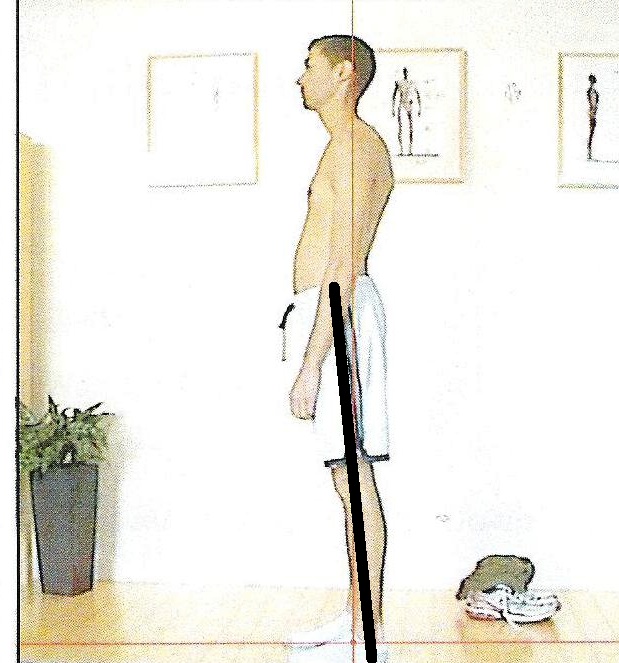
What happens here is the head of the femur is constantly pushing forward on the front of the hip capsule. (Femoral anterior glide.) Bottom of the leg goes backwards => top of the leg goes forward. Similar to a lever.


But you decry, “I sit all day! My hips are always flexed! I need to stretch my hip flexors.”
Sitting can cause the same issue with the femoral head as always standing with the hips in extension. Because the majority of people’s weight is on their ass when they sit, this is where the majority of gravity is pushing. Pictures will illustrate this better. The femoral head is where your ass is.

Rotate the diagram and:

Again, notice the femoral head is being pushed forward all the time.
Next, let’s compare some of these positions with the ways most stretch their hip flexors.
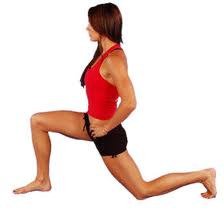

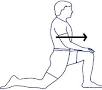
You should be starting to see too many similarities…
Some anatomy
So if a person’s hip pain is caused this way, which it very often is (if it’s not it’s probably from the lower back), their hips are often in extension / the femoral head is always being pushed forward. Therefore, the hip flexors, namely the psoas, is often long / underused / weak and the hip extensors, namely the adductor magnus and hamstrings, are tight / stiff / overused.
Hip often in extension / femoral head always being pushed forward = hip flexor(s) are likely LONG and hip extensor(s) are likely SHORT / STIFF.
Unfortunately, this does get more complicated. Because not all the hip extensors are overused. The glute max and posterior gluteus medius are typically not working as well as they should. Because they attach to the head of the femur and pull it backwards, you can see how if these muscles aren’t working well the head of the femur glides too far forward.

View from the back of the legs. Glute max and glute med can pull the leg backwards. (Hip extensors.)
-> More details on the glutes: Rethinking how and why you’re training your glutes
Despite what T-Nation would have you believe, anatomy and movement isn’t as simple as all hip flexors are short so all hip extensors are weak, or vice versa.
An example: Take someone with hip issues and have them perform a prone straight leg raise:
You’ll typically see the hamstrings and adductor magnus overwhelmingly perform the movement. They will contract way harder and way before the glute max ever does, despite all the muscles being hip extensors. If you can’t see it, placing one finger on the glute with another on the hamstrings usually gets the point across: you often feel the finger touching the hamstrings get pushed into well before the finger touching the glute does.
Quick summary so far
Hip pain issues are very often due to the hips being in extension. This elongates the psoas muscle and often the glute max and posterior gluteus medius are not working optimally (they contract too late / not at all).
Back to the typical way people purport you should stretch for hip pain:
What is this stretch doing? It’s putting the hip into extension without contraction from the glutes, and it is elongating the psoas. In other words, it is doing all the things that typically cause hip pain!
Why on earth would we do this stretch for someone with hip pain? We’re putting them into the same exact position which is causing them pain!

-> Many people who have hip pain walking have the pain when their leg swings behind them. This is why: Relieving hip pain while walking
Again, not everyone on earth has an anterior pelvic tilt or tight hip flexors. (Eh em, T-Nation and internet gurus).
In fact, the stretch that will be best for someone with hip pain is almost always a hip extensor stretch. Like the Backward Rocking stretch:
Why? Because the hips are in extension / the femoral head is pushing forward all the time; do the opposite i.e. put the hips into full flexion and push the femoral head backwards, and wa-lah, pain relief.
Furthermore, if someone has a hip history, you can see, if the hip is placed into extension, it is crucial the glutes be contracted to help pull the femoral head BACKwards. Doing any type of direct hip flexor stretching for people with a hip history is often a bad idea though. At least until their symptoms calm down.
This is crucial because someone like Dan (pictured above) figured out he had issues with his TFL, however, the last thing he wants to do is a bunch of stretching for the TFL where he is putting his hip into more extension. After all, his hips’ natural position is already extension. He especially doesn’t want to be doing this if his glutes are not concurrently contracted. He has to attack loosening his TFL from a different manner.


Andrea
May 31, 2015
Thanks for posting this! Sorry to be so forward, but I’ve always had problems with my hip, especially during intercourse. It was so bad that my hip would literally lock, causing me to kick my then-SO off of me and off of the bed (that’s not en exaggeration…it was THAT bad and THAT fast). I remember it hurting ever since I was little. Any time I would try the hip extension machine at the gym, it would KILL my left hip. I’d try thousands of stretches trying to stretch my hamstring, but it only makes it worse. When I *do* do hamstring stretches, I end up with—what my doctor and I always associated with—my herniated disc acting up. But, I find it funny it only acts up after trying to stretch my hip.
reddyb
June 1, 2015
I hear about hip issues during intercourse more than you’d think. Well, the kicking off the bed is new :).
The repeated hip extension -thrusting- is usually what’s ticking off the hip in this case.
In terms of stretching the hamstrings, this could be helpful: http://b-reddy.org/2013/07/29/better-exercises-to-stretch-the-hamstrings/
Cindi Schultz (@CindiSchultz)
June 9, 2015
Hi Brian – holy #$%^ am I happy I found this post. I’ve been dealing with hip/low back pain for 5 years. A massage therapist was the only one to have moderate success with my pain, I’m going to send this to her. Pretty sure she had a couple pieces of this puzzle and this will add to her good results. Since I moved from where she’s located I’ve been mistakenly trying to stretch the ever loving hell out of it. I do have to say that foam rolling (with nubs of course) my glutes has been a great pain reducer, but now realize I’m ruining that by moving into the stretches. So now I’ll stop stretching and add the backward hip rock you described above.
I just looked at “You can’t always be balanced” and “quick notes on piriformis syndrome” and wanted to ask you about that – I have about the same or less flexibility in my right hip as Sarah in the balanced video, but only since this issue developed, not my whole life. I can’t cross my right ankle across my left knee-can barely get it to mid shin. I also have developed a pretty significant length difference. My right hip feels so much higher than my left (or more accurately it feels more contracted), but the right side which is the side that’s painful is the longer side-this has continually confused me. I have always had significant hyperlordosis, and it’s getting worse the longer this stays a problem. Will strengthening my abdominals while I use your suggestions add to getting this solved? (Also looking at “correcting a swayback posture” so maybe I jumped the gun with my question I’ll be reading as much as i can…SO MUCH GOOD shit here!!). Thanks for the time you give to everyone posting.
reddyb
June 11, 2015
Hey Cindi,
Glad to hear some things here have been of use! Thank you for sharing the site with others.
I’d give this a read regarding the hip positioning and mobility you’re asking about. It mentions some of the musculature which can affect what you’re describing. http://b-reddy.org/2013/05/09/talking-about-hip-retroversion/
I discuss leg lengths here too: http://b-reddy.org/2012/12/14/properly-assessing-leg-length-discrepancies/
Strengthening the abdominals can help, depending on what you mean by that. Doing crunches, planks, commonly associated exercises here, all with the aim of doing more weight or reps, isn’t what I mean here. Something like straightening your leg without your lower back arching is more in line with what I’m saying. This doesn’t always coincide with strengthening though.
Example here: https://www.youtube.com/watch?v=iY3lmig5fKw
Cindi Schultz (@CindiSchultz)
June 13, 2015
Thank you Brian, great info – the ab exercise is interesting, it’s tough to keep my back flat against the floor; takes practice.
reddyb
June 15, 2015
You got it.
It’s tougher than a lot of people expect.
hippy
June 22, 2015
Any ideas for front-outside nervey hip pain (and numbness) as well as pins and needles in the leg due to someone being bent forward in an aerodynamic tuck on a time trial bike for many hours? Wouldn’t hip flexor stretches work in this case as they are the opposite of the torso-bent-forward position on the bike? Thanks!
reddyb
June 24, 2015
The being bent over is the problem aka the lower back being rounded is the problem. Stretching of any kind is unlikely to help this. You need to work on the cause i.e. how the person is bent over.
Bend over with less lumbar flexion and symptoms may subside immediately. Adjust seat height, handlebars, don’t allow as much lumbar flexion, etc.
Joe D
June 25, 2015
Could this be Meralgia Paraesthetica? I’ve had it for years (and I feel like it started when I began riding a TT bike), but since I have a history of multiple issues (back and hip) it was always hard to determine if it was a back thing (likely) or some type of femoral nerve issue. Echoing Brian, pins and needle sounds like a back issue tho…
hippy
June 25, 2015
Yeah, probably. I bought a kindle book about it last year and was doing a bit of ‘nerve flossing’ stretches from it which may or may not have helped. I always assumed the issue was with my hip because that was the area getting squashed and that was where the pain was. I’ve also had no back trouble of any kind (other than a little bit of ache after long rides but that seems to go away with some hamstring stretching) so didn’t think it could be a back issue.
reddyb
June 26, 2015
This is one reason nerve stuff is harder than others. It can be tougher to find the source of the pain. (And longer to change it once you find it.) But there are plenty of people who don’t feel they have a back problem, yet do have a knee, hip, or foot issue. They just don’t know it’s from the lower back. I know stories of people getting knee replacements, only to six months later have zero change in their knee symptoms. A couple months of working on their lower back? Knee issue was gone. Scary, but it’s happening.
As I said to Joe though, you can’t exactly address one without addressing the other. Another example can be found in the following video. It’s common to see the lower back come off the support to help fully straighten the leg in this exercise. Keep the lower back flat -only “focus on the lower back”- and the entire lower limb’s movement has changed though. Whether it doesn’t straighten as much, the muscles work differently because they’re in different positions (length-tension relationships have changed), it feels different because the nervous system is in a different position, etc.
reddyb
June 26, 2015
I tend to not group things in those terms of diagnostics. I find that ends up being a rabbit hole.
Most hip issues have something concurrent going on at the lower back. Anything “nervy,” burning, radiating, pins and needles, in the lower body, is pretty much always from the lower back. The back of the thigh is often more common than the front, but whether sciatic or femoral nerve, it’s probably the lower back.
Again though, you can’t really address one without the other. If you want the lower back to move differently, the hip is going to move differently as well.
Paul
June 25, 2015
Hello Brian, i’ve been struggling from hip pain for the past 3 months (for no apparent reason), which my chiro and osteo were not able to help with. Typically i suffer the most after sitting for about 20 minutes or so. Getting up is difficult as the outer right hip is in agony and tight as hell. It takes me 5 minutes to walk it off and it never fully goes away. I was told to do stretches which have not helped (should have read your blog 3 months ago). I’m 37, 5 foot 6, 130 pounds. I sit most of the day but do play hockey once a week and run 3-4 time a week. I’m not sure whats going on and can use any advice. I’m very discourage since I’ve been dishing out money for help without any improvement. I’m not well versed on all the terminology, but when i look at pictures the right TFL is the exact location where i have tightness. Any thoughts would be appreciated…
Thanks!
reddyb
November 10, 2015
Hey Paul,
I’m sorry, I think I missed this comment way back. Was not intentional.
The first thing I would do would be to assess your hip structure. One of the main ways to do that can be found here: http://b-reddy.org/2013/05/09/talking-about-hip-retroversion/
Once you have a baseline of the structure, you can then make modifications to how you sit, if it ends up being applicable.
If you’ve played a good amount of hockey, hockey players are notorious for having different hip structures, and causing hip issues in general.
Sorry again for the delay.
Rick
August 23, 2015
Hey Brian,
First of all. Your blog is incredible. It has helped me tremendously. Thank you!
You wrote: “He has to attack loosening his TFL from a different manner”. How would someone do that? Loosen the TFL while not putting pressure on the anterior capsule.
reddyb
August 25, 2015
Hey Rick,
Thanks for the nice words. That’s great to hear things have been helpful.
In my 6 Exercises To Loosen The IT Band manual, 5 of the six would qualify for what I’m talking about with that quote. If you purchase(d) the manual, email me and I can let you know the modification I’d make.
(link if needed- http://b-reddy.org/2013/08/20/6-exercises-to-loosen-the-it-band/ )
Darren
October 23, 2015
This is me – over stretching hip flexor (in all directions!) and susceptible posture. Finally an answer.
Would gentle squats be good for alleviating this and strengthening the hip joint? Are there any exercises you could recommend?
reddyb
October 27, 2015
Hey Darren,
Did you see the exercises in the post? I also discuss other exercises, such as a type of squat -“toddler squat”- in the comments.
http://b-reddy.org/2012/11/26/my-favorite-mobility-corrective-exercise-the-toddler-squat/
Ken
December 14, 2015
I think this analysis of the hip is flawed. If we are analyzing the hip you need to include hip movement into the analysis. You analyze the subject’s posture posture from head, knees, and feet but ignore the hips entirely as if the the area from the head to the knees are one rigid body. It isn’t. I don’t think you can simplify an analysis to such an extent especially if we are looking at the hip specifically.
More accurate body diagram including spine, hip, femur.
o head
/ Rounding of thoracic spine
\ Extension of lumbar spine
o hip (notice that the hip is not in extension but in flexion)
/ femur
\ knee
o feet.
If we look at the subject’s posture with the idea that the hip and spine as moveable parts just as you do with the knee joint then it becomes more apparent that the subject has anterior pelvic tilt. If you look at the excessive lumbar arch, rounding of thoracic spine and how the lining of the top of the angle downward it should be easier to see that anterior pelvic tilt is there.
You stated “the femoral head is pushed forward all the time.” when sitting. Well if the femoral head is pushed forward all the time. It should adapt to a more forward position, therefore anterior pelvic tilt (forward tilted pelvis). if the pelvis is tilted forward then that means the hip is in constant flexion. Thus you want to improve extension.
How do you improve extension?
Strengthen the glutes and hamstrings. Stretch the hip flexors.
I think your approach to strengthen the extensors is the right way to fix the problem but the analysis is wrong. Let me know what you think.
reddyb
December 15, 2015
Hey Ken,
I’m not sure if you’re saying the outline of people in this post is flawed, or you’re trying to make a general case. I’m assuming it’s the latter, as I don’t think one could argue the lines I drew mean the femurs are angling back, not forward.
So if it’s the latter, then you may be confusing an anterior pelvic tilt for automatically meaning the hips are in flexion. The hips can be anteriorly tilted while the femur is extension. Discussed here: http://b-reddy.org/2013/07/21/looking-at-pelvic-tilts-the-hips-only-tell-you-part-of-the-story-an-anterior-pelvic-tilt-doesnt-mean-your-hips-are-flexed/
A person can also be seated with a posterior pelvic tilt. As you said, an anterior pelvic tilt goes with lumbar extension. How many sit with their lumbar *flexed* though? (Posterior tilt.) A lot. This is on my writing to do list. Illustrating sitting down does not mean the hips are anteriorly tilted.
Regardless though, gravity dictates pulling the femur down when a person is sitting. The chair dictates opposing that force i.e. pushing the femur upwards. Unless the femur goes through the chair, the femur is being pushed up. How much can vary, and whether it’s a problem can of course vary. But it’s getting pushed.
I’m not sure what you mean here. The femur and pelvis are separate. The pelvis can do whatever it wants, but the femur can still be pushed forward. This is one reason those with femoral anterior glide issues will often have pain with hip flexion and hip extension. The pelvis doesn’t automatically dictate what the femur will do. The femur may very well adapt to a more forward position, but that adaptation may be painful!
I also want to mention I reference multiple movements in the article, as well as the comments. I by no means make the case all that needs to change is posture. How someone moves is critical. With that, I don’t outline an approach to strengthen the extensors. I outline some very specific ways on *how* to extend the leg. Not just strengthen the leg into extension. I discuss this in the comments a fair amount. That it’s not just strengthen a muscle, like the glutes for instance, but it’s improve upon how and when they engage.
Hope that clears some things up.
Mauricio
December 29, 2015
Hi Brian
I’m 28, and a pretty active soccer player. I usually do strength training (moderate lifting ) 3 -4 days a week and play competitive men’s league soccer on sundays, full 90 mins.
On May 21st I started having issues in both of my groins, I could play for about 15 mins, then it felt like I couldn’t lift my knees while running past by belly button. I had PT for about a month. Then went back to playing. Bad idea.
My season has been over, but now I have pain in my groin, pelvic area, glutes, and hamstrings running all the way down my leg. It even hurts when trying to get out of my bed. PT figured it was overuse, but I haven’t kicked or ran in several months. Still however to loft 3-4 times a week. Most pain is in right hip. It’s like a deadly triangle. Groin, pelvic, hamstrings, glute and some tightness on quad.
Any advice?
Mauricio
reddyb
December 29, 2015
Hey Mauricio,
What type of stuff did you do in PT?
If the pain is moving around from the front of the leg to also the back of the leg, I’d be looking more at the lower back. The hip and back often go together with this stuff, but often the focus wants to be more on the back than the hip (your PT may have been just the hip) when the pain is moving around like that. Pain around the glutes / hamstrings, which is radiating like that, is often from the lower back.
Again, doesn’t mean the hip isn’t part of things. It just might be not sufficient to only focus on that.
Next, with PT, you may have been trying to strengthen things, but at this point you can be pretty sure the issue isn’t being caused by soccer. As you said, you haven’t played in a while. So, you want to then start looking at what do you do during the day? How do you go about your daily habits? Are you doing something to cause issues, and maybe soccer just let you know they were there. Soccer may not have caused things, but it could have exacerbated an already sensitive area, which now you need to modify you daily life to get that area to calm down.
Let me know if that’s helpful.
Mauricio
May 7, 2016
Update:
Things have been getting slightly better. I have a desk job where I sit down and I think that may be effecting my hips as well as lower back.
Ive held off on the free weights for my workouts and have been focusing on body weight exercises. Seems to help.
At this point soccer is back around, and im able to play, but man it feels like i have lost a step in explosiveness and overall speed. I will say though i think your on the money about lower back issues.
I rolled around on a tennis ball for my lower back one night for some tissue release and the next day was like heaven.
Do you have any recommendations for some lower back stretches?
reddyb
May 10, 2016
Hey Mauricio,
The backward rocking exercise is a good lower back stretch.
theintolerantlife
February 1, 2016
I ended up here after my mother shared this on a post I made in our chronic pain support group – I have suffered from pelvic floor disorder for most of my life (possibly created by 10 years of ballet followed by 10 years of competitive volleyball, or at least exacerbated by it). Back pain is an issue, as well as ankle, knee and hip pain. For the pelvic floor disorder, I had months of biofeedback therapy and trigger point release that helped quite a bit in my early 20s. In my early 30s I saw a different PT who did trigger point and some exercises. It was helpful short-term but didn’t really leave me with a long-term plan. I am back to being as bad as I have been – the pelvic floor muscles are constantly tight and painful, sometimes with twitching and spasms. If I don’t I stretch and use a foam roller and tennis balls regularly, it becomes a big problem. Last week I began a series of stretches that included many hip flexor stretches, and almost immediately started experiencing hip pain. What you read here makes sense to me, particularly since I KNOW I have problems with my psoas. Since you’ve been so kind to other commenters, I’m wondering if you have suggestions for important stretches/strengthening exercises for me? My doctor wants to refer me to another PT, and I can’t really afford another waste of time. 🙁 Many thanks for your article. 🙂
reddyb
February 2, 2016
Hey there,
Unfortunately I have extremely limited experience dealing with pelvic floor pain. Certainly not enough to give any general recommendations. I know a good amount swear there is something connected with the type of stuff I wrote about in this post and such, but I can’t say I’ve worked with anyone to give it a shot.
You’re welcome to take a look at this, where I could see if I could be of help, but again, not my area of knowledge: http://b-reddy.org/2013/06/20/the-remote-client-process/
The Washington University in St. Louis physical therapy program, a program I hold in very high regard, does some work with pelvic floor pain. You may want to research them and see if anything worthwhile comes up. Sorry I can’t be more helpful.
Sabs
April 11, 2016
Hey there, I’m a bit confused by your diagrams. You’re saying the femoral head is always being pushed forward, and that makes sense in the standing with a sway back diagram, as well as the hipflexor stretch diagram, but in the seated diagram it seems like you’re ignoring the angle of the hip socket in relation to the femoral head. In my mind, the front of the head is pushed against the top of the socket, not the front. Please correct my if I’ve read this wrong.
I did try the exercises of lifting my they past horizontal and it absolutely provided temporary relief, but I find that I have a much harder time doing this exercise with my foot below my knee, and it’s prohibitively painful to do it with my knee further centre than my foot, even by an in inch.
Can you suggest any exercise that could provide some relief to this sort of motion and to increase the range of motion when trying to bring my knees together in a seated position, while having my feet at shoulder width, like one might while holding a plate in they’re lap, or as I like to call it, the Mr Bean position.
Thanks, and keep up the good work!
Sabs
reddyb
April 12, 2016
Hey Sabs,
I see what you’re saying. This is a good question. I plan to write something more in depth about sitting and the hips, but for now-
-When sitting, if the hip did not posteriorly tilt *at all,* then the femoral head would be getting pushed purely superiorly, relative to the acetabulum.
-However, barely anyone sits like this. Therefore, once the pelvis posteriorly tilts *at all*, the femoral head, relative to the acetabulum, will be getting pushed anteriorly and superiorly.
-Relative to the other structures, ligaments in front of the hip, the hip capsule, etc., then the femoral head is still being pushed anteriorly. Regardless of scenario. In other words, the femoral head is being pushed into the anterior hip capsule, regardless.
Hope that makes sense, as your question is valid.
For your exercise question, I think you may want to take a look at these:
http://b-reddy.org/2013/05/09/talking-about-hip-retroversion/
http://b-reddy.org/2015/07/29/on-structural-adaptation-limitations-of-the-hip/
https://b-reddy.org/2015/08/03/hip-mobility-issues-in-basketball-players-why-the-lack-of-internal-rotation/
Sabs
April 13, 2016
When you explain it like that it makes a lot of sense. Almost too much, because now I struggle to think of a comfortable way of sitting or laying that doesn’t put my femur in that position of being pushed forwards. In the mean time I can feel tightness in the front of my hip even as I simply walk with a normal stride, and pain when I bend down to tie my shoe, and a general feeling of warmth in the front of my hip, probably from inflammation. If it is true what you say in your articles, that they are caused by boney growths, then that is really a disappointing proposition, since it doesn’t sound like I am likely able to improve my hip mobility in either direction, and just have to endure pain in extension and in flexion.
reddyb
April 15, 2016
Think about it more. If you sit on a soft surface, then is it going to be much of an issue with a soft surface pushing the femoral head? Probably not.
If you’re laying down on your side, is the femur really getting pushed forward then?
Those are just two examples.
I didn’t say anything like bony growths means one has to endure pain in extension and flexion. Really read those articles. I’m saying if someone does have structural limitations, they need to be careful with how they flex and rotate their hip. (I don’t even mention anything about extension?) In no way do I say in those articles “You’re screwed.” I give example after example instead about how to take care of the hips should one of those situations arise.
One has to find ways to adapt.
RobJ
May 24, 2016
Hi Brian,
So informative, such a great site.
I’ve tried a couple of your suggested stretches and wow does it feel such a better stretch. One bit of advice is where should I concentrate on initially as I have so much trouble on my right side. I always feel like I have a tight right adductor, quads feel so tight (the quad stretch really showed that), have had nerve pain like sciatica on the right, plus wake up and the outside of the hip is really painful until it gets loose.
Do you think stretching the quads and hips in backward rocking is a good thing or just concentrate on one. I gave up running years ago due to ITB on this side it just seems like everything is screwed on this side (not sure it the arthritis in my left knee is over compensating or just bad right groin from soccer but obviously some imbalance is tightening everything on this side).
Thanks,
Rob
reddyb
May 26, 2016
Hey Rob,
Thanks for the nice words.
This sounds a little more appropriate for the remote client process as lower back stuff can be tricky, but in general the backward rocking is likely a good move, and you could attempt to combine it with the IT band manual. While the focus is obviously the IT band (quads are stretched some too), the lower back is addressed a good deal as many of the exercises involve loosening up the limbs while not moving the back. Lower back issues often manifest from the lumbar spine moving too much, too often. So exercises which keep it in place tend to be a good start.
IT band manual: https://b-reddy.org/2013/08/20/6-exercises-to-loosen-the-it-band/
Remote client process: https://b-reddy.org/2013/06/20/the-remote-client-process/
Samya Aich
July 6, 2016
Hey,I am a 23 year old guy, I have recently started to feel a severe piercing pain when moving my hips.Initially i felt the pain near the spinal ending just near the buttock crease.I feel the pain for a fraction of a second while some particular movements like getting out of a car, turning while sleeping, but no pain while sitting ( Actually sitting eases the pain for a while, as does a hot water bag). The pain started suddenly after a 2:30 hour flight and kept getting worse for 4-6 days. Now, its the same pain I feel it the most in the morning. The pain was so much that it caused me to limp.
I am a researcher and my work includes long hours of sitting at the desk.
Can you suggest something.
reddyb
July 8, 2016
Hey Samya,
What do you research?
Not much info for me to go on, but this is where I’d start: https://b-reddy.org/2013/09/09/some-quick-notes-on-piriformis-syndrome/
Scroll down to piriformis section here: https://b-reddy.org/2014/01/21/my-visit-to-stanford-universitys-clinical-anatomy-lab/
And you may want to take a look at this as well: https://b-reddy.org/2013/06/20/the-remote-client-process/